In Chile, as many as 95% of homes in the south-central regions use firewood, causing severe air pollution and respiratory issues. In Switzerland 65% of the households still rely on fossil fuels. To address the slow progress of the energy transition in Chile and Switzerland, a team of researchers from the two countries has initiated a joint research project.
Researchers from the University of Concepción, University of Talca, Austral University (Chile), and the Paul Scherrer Institute PSI (Switzerland) seek to improve residential heating policies through the collaborative project Promoting Sustainable Heating Under Energy Poverty: A Life Cycle Approach, starting in 2026.
Adolfo Uribe (SETI, NENRE EfD-Chile, and PSI-LEA) leads a multidisciplinary team including Marcela Jaime, Carlos Chávez, and Cristóbal Vásquez, (SETI and NENRE EfD-Chile), Alejandra Schueftan (Universidad Austral de Chile), and researchers Alvaro Hahn-Menacho, Karin Treyer, and Maria Myridinas from the Technology Assessment Group (TAG) at the PSI Laboratory for Energy Systems Analysis (LEA); to use a multidisciplinary approach that combines Swiss experience in Life Cycle Assessment (LCA), a method for evaluating the environmental impacts of a product, process, or system across its entire life cycle, from raw material extraction to disposal, with the Chilean team's deep understanding of energy poverty.
Seeks the true cost of energy
The researchers expect to strengthen the collaboration between Chile and Switzerland in advancing the transition towards sustainable heating through this project.
The goal is to estimate the “true cost of energy” and create a comprehensive and fair tool for designing heating policies to reduce carbon emissions and to ensure that subsidies for the replacement and adoption of new heating systems equitably benefit the most vulnerable households.
And for the first time, LCA will be systematically linked with energy poverty to estimate an integrated social cost of energy.
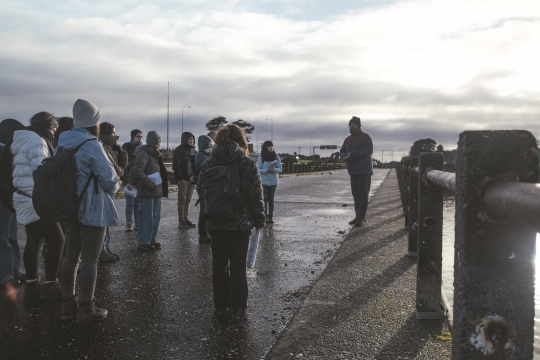
To this end, the study will be conducted in Ancud on Chiloé Island (Chile). This isolated region will serve as a case study to understand how households with limited access to energy efficiency can achieve fair climate adaptation.
“Ancud serves as a typical case due to its high levels of energy poverty, the pressure on native forest ecosystems due to intensive firewood use, and the challenges related to improving thermal efficiency,” explains Adolfo Uribe.
”Preliminary exploratory results may be shared during the second semester of 2026, and “we expect to present them at the annual NENRE–EfD Chile workshop and in a future SETI workshop”.
This research cooperation between Chile and Switzerland is funded by a Partnership Grant 2025 of the Leading House for the Latin American Region, hosted at the University of St. Gallen, mandated by the State Secretariat for Education, Research and Innovation (SERI) of the Swiss Confederation. It is to be implemented during 2026, and its results could serve as a reference for bilateral climate finance agreements between Chile and Switzerland under Article 6 of the Paris Agreement.
The project also involves several institutions from both countries, such as the Municipality of Ancud to support fieldwork and facilitate access to households, Minergie Chile and EBP to contribute their expertise in Swiss sustainable building standards, and the Direction des Services industriels (SiL) for the exchange and dissemination activities, given their interest in heating strategies and thermal insulation programs.
By Belén Pulgar.