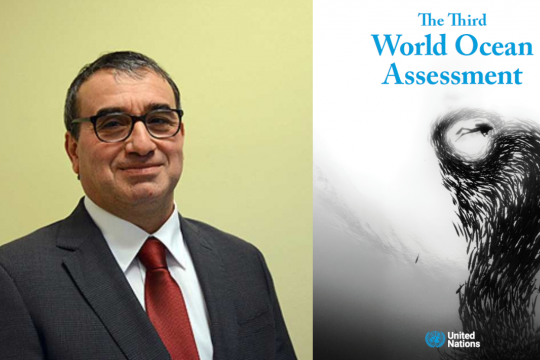
EfD researcher Carlos Chávez, participated in the United Nations’ Third World Ocean Assessment (WOA III). This comprehensive report brings together the work of more than 650 experts from around the world to evaluate the state of the oceans and the challenges facing sustainable management.
The assessment aims to provide robust scientific evidence to support decision-making on sustainable ocean use. It also seeks to advance the United Nations Sustainable Development Goals, particularly SDG 14, which focuses on conserving and sustainably using marine resources.
Learn more about the Third World Ocean Assessment (WOA III)
Carlos Chávez (University of Talca and Principal Investigator at the Center for Applied Research, CIA-INCAR²) collaborated with and exchanged knowledge with specialists from various disciplines and regions worldwide. He co-authored the sub-chapter dedicated to international trade in seafood products, contributing to the analysis of how trade can generate economic benefits while simultaneously presenting challenges for environmental sustainability and coastal communities.
The role of international trade
The effects of international trade on global seafood supply chains can be positive or negative, depending heavily on the institutional and regulatory context in which they operate.
On one hand, access to international markets can boost incomes for producers and coastal communities, create jobs, and expand economic opportunities in regions that rely heavily on fishing and aquaculture.
On the other hand, rising global demand can increase pressure on marine resources and lead to negative environmental impacts if adequate regulatory enforcement mechanisms are not in place.
Carlos Chávez highlighted, among many other things, that production may shift to countries with weaker environmental regulations or limited monitoring capacities. This shift increases the risks to marine ecosystems and the vulnerable communities that depend on them.
By Belén Pulgar.