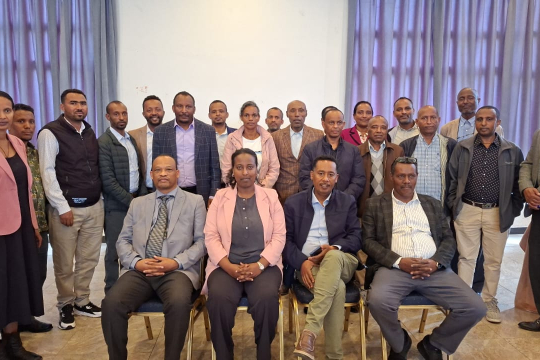
A dialogue workshop within the Inclusive Green Economy (IGE) program was hosted by EfD Ethiopia at Addis Ababa University. The program builds the capacity of senior civil servants and policymakers. This year, the IGE fellowship will focus on the forest and water sectors within the program’s broader framing of a just low-carbon transition in sustainable land use.
The objective of the dialogue was to gauge what government and researchers working in the sector consider urgent. Around the table were the senior advisor to the Ministry of Water and Energy, along with representatives of the Ministry of Agriculture, Ethiopian Forestry Development and the Environmental Protection Authority, academicians and other relevant stakeholders. The themes emerging from the day will be taken to counterparts in Kenya, Uganda, Rwanda and Tanzania, where the aim is to align on regional priorities.
Forests contribute significantly to GDP and emissions reductions
Dr. Abebe Damte Beyene, IGE lead for Ethiopia, formally opened the dialogue. Dr. Zenebe Gebreegziabher, senior research fellow, then set the stage with an overview of forest ecosystem services and their economic weight. Forestry contributes about 6 percent of Ethiopia’s GDP directly, he noted, and more than 12 percent once the indirect benefits of forests are counted. Drawing on recent evidence, he showed that dependence on forests is not evenly spread. That distributional detail matters for policy design.
Dr. Yitebitu Moges, National REDD+ Coordinator at Ethiopian Forestry Development (EFD), followed with a presentation on the forest–water–climate nexus. Dr Yitebetu Moges asserted that recent government restoration efforts have started to play an important role in bringing back forests. Forest cover now stands at 23.6 percent, some 26.75 million hectares, and the forest sector delivered roughly 80 percent of Ethiopia’s emission reductions between 2020 and 2024.
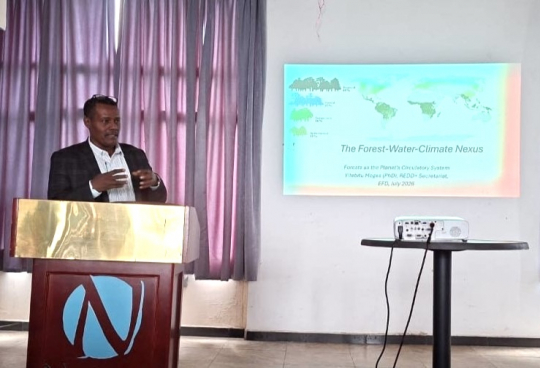
Describing forests as the planet’s circulatory system, he explained why the hydrological cycle matters so acutely for a country like Ethiopia. Forests generate and recycle atmospheric moisture, regulate stream flow, filter water and recharge aquifers. That makes them a direct determinant of rainfall, food security and rural livelihoods in a mountainous, drought- and flood-prone economy whose development ambitions rest on water resource development.
Both presenters closed on the same prescription: more research to pin down these highly contextual relationships, and a wider use of economic and complementary policy instruments to act on what the evidence shows.
From diagnosis to sub-themes
Participants then divided into four groups to work through three questions: what are the most binding challenges at Ethiopia’s forest–water interface, who bears the costs, and why have current policies not fixed them, and which sub-themes could the IGE program tackle in 2026/27.
The challenge diagnosis exercise converged quickly. The main issues raised here include sectors and ministries that work in parallel rather than together, with overlapping mandates and weak integration across and within levels of government, and the incentives reaching regions and households currently not rewarding conservation efforts. Scarce data, limited monitoring and unaddressed research gaps were some of the challenges echoed in the various discussions.
The proposals that recurred most followed directly from that reading. Valuation of forest hydrological services drew the widest support, on the argument that Ethiopia cannot manage what it has never priced, and that the forest contribution belongs in budget allocation and in the national accounts.
Integrated landscape and water resource management was raised repeatedly, taking in catchment protection and riparian buffer zone restoration, alongside agroforestry-based restoration.
Payment for ecosystem services for water recommendations ran through several groups. To address identified challenges, participants converged on a mix of economic instruments including payment for ecosystem services, subsidies and incentives for conservation and certification schemes alongside regulatory and educational awareness programs.
Looking ahead
The sub-themes identified in Addis Ababa now go to the IGE teams in Kenya, Uganda, Rwanda and Tanzania, to find the common ground on which a regional agenda can rest. A new group of civil servants will be recruited into the fellowship for 2026/27 to work around identified priorities and build capacity in the region.
By: Saba Yifredew
|
About the IGE in Practice program |