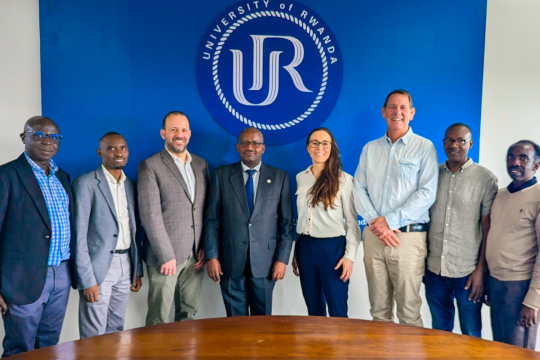
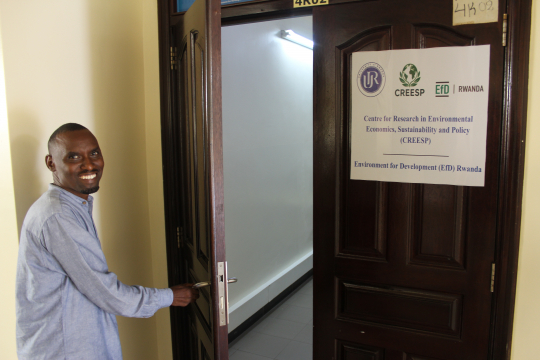
It's been in the making for years now - the establishment of the new center, EfD Rwanda. We can now share some more information about its developments and operations. Meet the new Center Director, Dr. Edouard Musabanganji!
How does it feel now that the center is formally in place?
The first meetings to establish the center, which I participated in, were in 2022, and I am extremely happy that our EfD center has become operational now. I am excited to contribute to establishing our center, worldwide, as an excellent environment for environmental economics. We feel extremely encouraged and supported by the peer EfD centers and our EfD Global Hub. This kind of cooperation will certainly enhance the performance of our local researchers and build our research capabilities.
What do you believe will be your most important contributions to the network?
We will contribute through collaborative research and by offering our knowledge to other EfD centers. Our team includes researchers with varied qualifications. Our main strengths are agricultural economics, environmental economics, natural resource management, biodiversity, circular economy, energy transition, and gender economics.
What are the most urgent priorities now, as Center Director?
My most urgent priorities are to fill key vacancies in administration and communication to ensure the smooth functioning of the center.
Together with the college leadership, we also aim to officially launch the center before the end of this year by engaging the private sector, policymakers, development partners, and other stakeholders to present our vision, objectives, activities, and strategy, and to increase the center’s visibility and impact.
Another key priority is to establish a strong and well-functioning Center Advisory Board that can provide strategic guidance and support the center’s long-term growth and sustainability.
In the near future, we plan to develop and submit curricula for a Master’s and a PhD program in Environmental Economics and Policy. In addition, a postgraduate diploma in Environmental and Social Risk Management is scheduled to be launched in September 2026. We are currently working on institutional approval and submission to the accrediting authority, and we hope to receive approval soon.
We also have strong plans to build the capacity of our research team in key areas such as grant proposal writing, policy brief development, green project design, monitoring and evaluation, and other skills that will strengthen our research excellence and policy engagement.
EfD has been active for years in Rwanda through the Inclusive Green Economy (IGE) program, but until now, coordinated in Rwanda by the Ministry of Finance and Economic Planning (MINECOFIN). What does that mean for your center?
The long-standing presence of the EfD Network in Rwanda through the IGE program provides a strong foundation for our center. It means that we already have an established, valuable network among policymakers, as many civil servants in Rwanda have participated in the program from the beginning.
Each cohort brings together new teams working on policy issues that are highly relevant to national development priorities. This creates an important opportunity for us to align our research and policy engagement with government priorities and strengthen evidence-based decision-making. We also hope that some of these IGE fellows will serve as our focal persons in their institutions. In addition, Abias Maniragaba and Fred Sabiti, both from the Ministry of Finance and Economic Planning (MINECOFIN) and active in the IGE program, have already been appointed and joined the EfD Rwanda team. Their experience and institutional knowledge will bring great value to the center and further strengthen our policy relevance and impact.
What are the most important challenges in your country and knowledge gaps that you will focus on?
We will work closely with the Ministry of Agriculture and Animal Resources (MINAGRI) to contribute to climate-smart agriculture, particularly by supporting research and policy solutions that can increase the currently low uptake of climate-smart agricultural practices.
We will also collaborate with the Ministry of Environment and its affiliated agencies to help fill capacity gaps, initiate joint projects, and provide evaluations and research outputs that can strengthen policy design and implementation. In addition, e-mobility and energy transition are important areas we are actively exploring.
Beyond these priority areas, we recognize several other sectors where our center can make meaningful contributions. We have drafted a five-year strategy that will guide our work and define our research and policy engagement priorities. This strategy will be discussed with our Advisory Board, and we hope to finalize it within the next three months. I look forward to this process and hope that our center will play an important role in ensuring evidence-based growth and sustainable development in Rwanda.
By: Petra Hansson