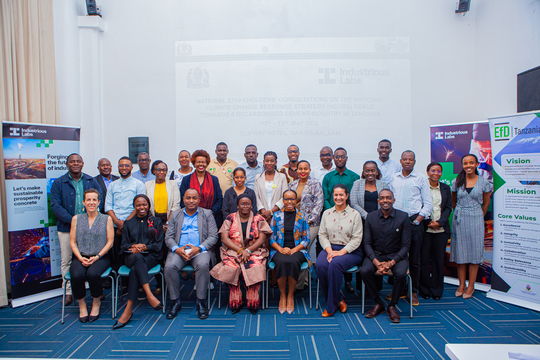
Tanzania needs cement for homes, roads, factories, and public buildings. But cement production also carries a climate cost. At a national consultation in Dar es Salaam, EfD Tanzania joined stakeholders to discuss how the country can build more while emitting less.
Like many developing countries across Africa, Tanzania is growing. New homes, roads, factories, and public buildings are needed throughout the country. Behind much of that growth is one essential material - cement.
This was the focus of a two-day national stakeholder consultation on cement decarbonization, held in May 2026 in Dar es Salaam. Supported by Industrious Labs, the meeting brought together representatives from government, the cement industry, development partners, and academia to examine how Tanzania can reduce cement-related emissions while continuing to support infrastructure development.
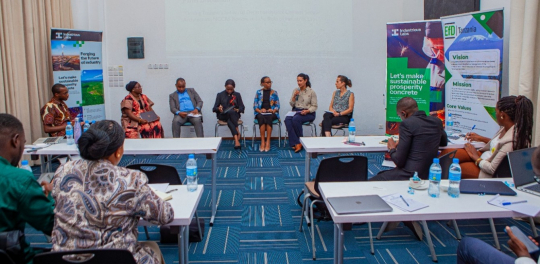
EfD Tanzania was represented by Ms. Fisha Isaac and Dr. Martin Chegere, who moderated a panel on cement, development, and climate change. Martin Chegere emphasized that addressing emissions from the cement sector requires more than technological solutions alone.
“Cement decarbonization is not only a technical issue. It is also a policy, data, and coordination challenge. If Tanzania is to reduce emissions while meeting its infrastructure needs, decisions must be informed by credible evidence, industry realities, and inclusive stakeholder engagement,” he said.
Echoing this perspective, Gloria Mgelwa, Tanzania Advisor for Industrious Labs, highlighted the role of the Tanzania Cement Decarbonization Table in fostering collaboration across the sector.
“The Tanzania Cement Decarbonization Table is designed as a collaborative platform where government, industry, researchers, and development partners come together to actively shape Tanzania’s decarbonization journey. Meaningful progress will depend on all stakeholders having a seat at the table and contributing to shared solutions,” she said.
Cement carries a carbon cost
Producing 1 ton of cement can require about 1.6 tons of limestone and release roughly 0.8 tons of carbon dioxide, excluding transport-related emissions. Industry experts explained that most emissions come from clinker production, where limestone is chemically transformed, and from the high temperatures required by cement kilns.
These figures show why cement, though essential for development, is also central to Tanzania’s climate conversation.
With Tanzania’s cement demand expected to remain high due to urbanization, population growth, housing needs, and major infrastructure projects, participants argued that the issue should not be viewed as a choice between development and climate action.
This perspective is particularly important for many countries in the Global South, where climate action is often presented as slowing development or requiring an economic trade-off. Instead, stakeholders emphasized the need to align industrial and climate policy so that economic growth can continue without locking countries into highly polluting pathways.
Practical solutions were discussed
One of the most important messages from the consultation was that cement decarbonization cannot rely on one solution. It requires technical, financial, policy, regulatory, community, and industry-based approaches working together.
Several possible pathways were discussed, including reducing clinker use, using alternative fuels, improving energy efficiency, updating cement standards, reforming public procurement, and raising consumer awareness about different cement grades and efficient cement use.
This is important because cement decarbonization is not only about factories. It is also about how buildings are designed, how materials are transported, how cement is used on construction sites, how standards are applied, and how much people understand the products they are buying.
Local materials part of the solution
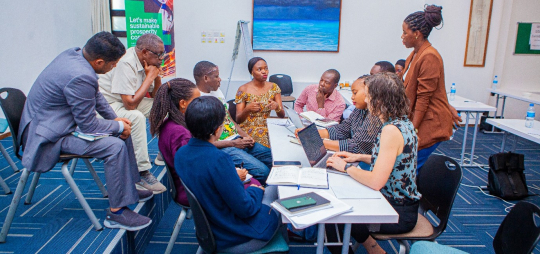
Dr. Alice Bakera from the University of Dar es Salaam’s College of Engineering emphasized the importance of first understanding and valuing what is locally available before importing solutions.
“Before we import solutions, we need to understand what we already have, give it value, and innovate from there,” she said.
Possible clinker substitutes and supplementary cementitious materials include pozzolana, fly ash, slag, clay, and biomass from agricultural waste. Several of these materials are currently being researched by Alice Bakera and her team.
Industry and communities matter
Participants emphasized that cement companies should not only be seen as targets of regulation, but as partners in designing practical solutions. Some stakeholders noted that imposing new policies without first understanding industry realities, including production costs, technical capacity, market pressures, and emissions data, could make implementation difficult.
Communities must also be part of the process. Community-based projects were presented as a way to generate local data, build trust, improve policy relevance, and ensure that interventions are meaningful for people affected by cement production, mining, construction, and environmental impacts.
Gender and inclusion were raised as cross-cutting issues, with participants noting that inclusion should go beyond women and youth to also consider low-income communities, informal workers, and people living near cement production or mining areas.
Dialogue must continue
Representatives from the Vice President’s Office emphasized that cement production greatly contributes to greenhouse gas emissions and should therefore be considered within Tanzania’s broader climate adaptation and mitigation agenda as the country works toward its Nationally Determined Contributions under the Paris Agreement.
For EfD Tanzania, the consultation was an important example of how research, policy, industry, and community perspectives can meet in one room. These conversations are not always easy. Government, industry, communities, researchers, and civil society may have different priorities, but that is exactly why dialogue matters.
By Fisha Isaac