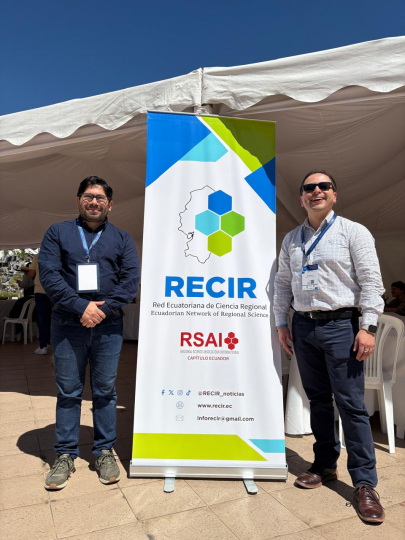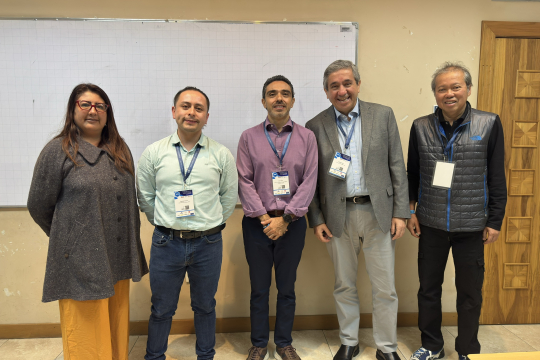
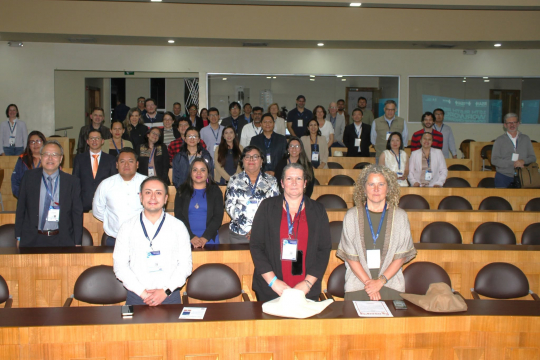
Mauricio Oyarzo, Deputy Director of NENRE EfD-Chile, presented new research on natural resource revenues and local government spending, chaired a special session on regional development, and contributed to discussions on strengthening international research collaboration at the 15th RSAI World Congress in Quito, Ecuador.
The Regional Science Association International (RSAI) Congress brought together scholars from around the world to discuss advances in regional science, territorial development, natural resources, and public policy. It was organized by the Ecuadorian Regional Science Network (RECIR) and the National Polytechnic School (EPN), the Congress, in Quito, Ecuador, from June 9–12, 2026.
Presented paper on resource revenues and local development
Mauricio Oyarzo organized and chaired the special session Spatial Dynamics of Local Public Finance: Fiscal Behavior, Intergovernmental Transfers and Regional Development, which featured contributions from researchers across Latin America and Asia working on local public finance, natural resources, intergovernmental transfers, and regional development.
During the session, Mauricio Oyarzo presented the yet-to-be-published paper Political Institutions and the Fiscal Transmission of Resource Windfalls, co-authored with Dusan Paredes (Universidad Católica del Norte, Chile).
Based on years of prior work, this paper tackles a big question: Why do different local governments spend the exact same financial windfalls in totally different ways?
The study shows how local government politics affects how money from natural resources is spent on public services and community development. It is also a part of a broader project on territorial governance, natural resources, fiscal decentralization, and regional development.
Previous project publications:
Building international research networks
In addition, Mauricio Oyarzo participated in the official meeting of the Regional Science Association International (RSAI) Council, serving as a Council Member representing the Latin American and Caribbean Regional Science Association (LARSA) for the 2026–2028 term.
The council meeting focused on strengthening international scientific collaboration, supporting early-career researchers, expanding global research networks, and discussing future strategic initiatives within RSAI.
"The RSAI World Congress provided an excellent opportunity to showcase high-quality research developed in regional institutions at one of the world's leading conferences in regional science,” said Mauricio Oyarzo, emphasizing the importance of international academic engagement.