EfD Nigeria has commenced implementation of the African Think Tank Platform (ATTP) project, designed to help African countries use homegrown research evidence to improve public policies and promote inclusive development.
The ATTP is an initiative stewarded by the African Union Commission (AUC) with regional economic communities as central coordination partners. The project brought together think tanks across Africa to produce policy-relevant research that responds to real development challenges in the continent. EfD Nigeria is one of the 13 think tanks selected for the first phase of the project.
The 13 think tanks are grouped into three consortia: Research Alliance for Inclusive and Sustainable Economic Development in Africa (RAISED Africa), Building Resilience and Impact through Dialogue and Galvanising Action for Evidence-Informed Policymaking (BRIDGE Africa), and the Consortium for Africa Cross-Border Evidence and Policy Sovereignty ( CACEPS), each focusing their studies on a range of thematic areas that are relevant to the achievement of the goals of the African Union Agenda 2063.
EfD Nigeria belongs to the RAISED Africa consortium with focus on four thematic areas: economic transformation and governance; climate change; food security; and human capital development.
The centre will implement studies and capacity development programs along the thematic areas in Nigeria, Ghana and Côte d’Ivoire. The project, which will run for two and a half years, is financed as an investment project by the World Bank, with implementation support from the ACBF and AUDA-NEPAD.
An inception webinar sets the agenda
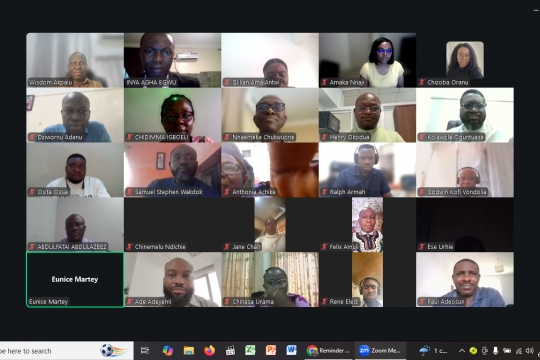
EfD Nigeria formally launched implementation of the project with an inception webinar that brought together major stakeholders from Nigeria and Ghana. A similar engagement is planned for Côte d’Ivoire in August.
The webinar provided an opportunity for participants to gain a shared understanding of the project's objectives, expected outputs and implementation timelines, while also allowing stakeholders to fine-tune the research objectives through their practical experiences.
Opening the webinar, the Director of EfD Nigeria, Prof. Nnaemeka Chukwuone outlined the project objectives, expectations and key areas of inquiry, emphasising the need for the project to produce evidence that is both academically robust and responsive to African policy and development challenges.
Rather than treating the research agenda as a fixed framework, the inception webinar created an opportunity for stakeholders to interrogate the priorities and identify how the research could better respond to shared developmental challenges in the two countries.
Participants were subsequently divided into the thematic groups for detailed discussions. The discussions focused on aligning the project's objectives with real-life challenges, policy priorities and the expectations of stakeholders in Nigeria and Ghana.
The thematic discussions sought to ensure that the project would capture both the common regional challenges and the country-specific realities that should inform effective policy responses.
Government commits to the Project
The importance of government partnership to the success of the project was highlighted during the inception webinar by the Director of Climate Change in Nigeria's Federal Ministry of Environment, Dr. Iniobong Abiola-Awe
Dr. Abiola-Awe pledged the support and cooperation of the Nigerian Government towards achieving the objectives of the project. Government participation will also be critical in ensuring that research findings do not remain within academic circles but are translated into evidence-informed policies, programmes and interventions.