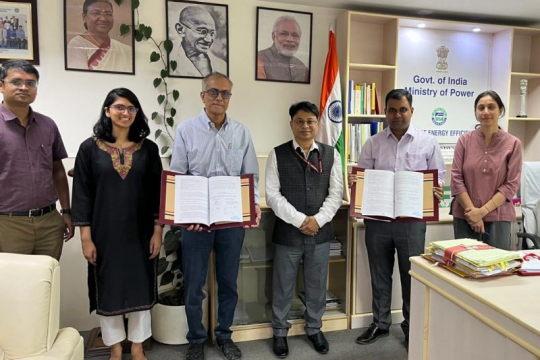
EfD India has signed a Memorandum of Understanding (MoU) with the Bureau of Energy Efficiency, Ministry of Power, Government of India, to support its data systems, policy evaluation, survey designs, and capacity building. The MoU was signed in April and covers collaboration over four years (2026-2030).
EfD will support work on energy efficiency
The Bureau of Energy Efficiency (BEE) is an agency of the Government of India responsible for developing programs for the efficient use of energy in India. The agency was created in 2002 and has carried out various audits and energy conservation programs, including labeling consumer appliances with energy performance markers to raise awareness.
As noted by the Bureau in its annual publication India Energy Scenario 2023-24, there are significant data gaps in its compilation of energy statistics. These range from information on the ownership and operation of captive power plants to data on real-time electricity demand by industry in the power exchange. Moreover, surveys conducted by the Ministry of Statistics and Programme Implementation (MoSPI) on energy demand in the residential and commercial sectors often do not align with the programs launched by the BEE. This is where EfD India will step in to assist the Bureau, as it plans to assist in data analysis, data management, and policy evaluation of BEE programmes, through the MoU.
Focus on data and capacity-building
The project's overarching objective is to strengthen BEE's data systems through policy evaluation, survey design oversight, and capacity-building initiatives. A core task is to ensure that databases are complete, internally consistent, and standardized across different Indian states to support reliable analysis. The team plans to analyze energy consumption patterns across manufacturing and industrial sectors. The team also intends to carry out spatial and temporal analysis to assess trends of consumption. Perhaps the most significant aspect of this project is focused on bridging data gaps, especially the ones outlined in the India Energy Scenario 2023-24. The team plans to collate data from various government ministries and surveys to fill these gaps.
The project also involves working with BEE’s data managers and IT team to update the Udit portal. This is a dashboard that provides a comprehensive database on energy efficiency and aims to create awareness to achieve India’s Nationally Determined (NDC) goals. The data analyses will be presented through visual charts and concise policy briefs to facilitate stakeholder communication and knowledge dissemination. These tools will aid decision-making at multiple levels, from program managers to state-level administrators.
A key element of this project is capacity building. The team has proposed to conduct training workshops for BEE staff and affiliated stakeholders. In addition, it will support the design of nationally or state-representative household and firm surveys to generate more detailed information on energy consumption, appliance ownership, energy efficiency, and investments in cleaner technologies. These surveys, potentially supported by smart-meter data, could provide valuable evidence for evaluating existing programmes and informing future energy-efficiency policies.
Longstanding engagement with government
This project is a continuation of EfD India's long-established engagement with the Indian government to support its capacity building efforts and policymaking on climate and energy. The center has previously worked with NITI Aayog, the Ministry of Finance, the Ministry of Petroleum and Natural Gas, and the Central Pollution Control Board, to name a few institutions.
More importantly, this project builds on EfD’s efforts to engage with governments of the global south, to support their energy transition commitments and reduce carbon emissions. This also aligns closely with a research and policy project carried out under EfD's Climate Policies for Development (CPfD) collaborative program, , where researchers are conducting a randomized controlled trial (RCT) to assess if providing information on the energy efficiency of household appliances influences the adoption of more energy-efficient air conditioners and refrigerators in India.
“This project offers a great opportunity to collaborate with the Government of India's key agency responsible for energy and the Indian carbon market," says Raavi Aggarwal, co-lead of CPfD and a co-Principal Investigator, on this project.
"Our partnership with BEE aims to advance research through an information experiment on nudging energy-efficient consumer behaviour, while informing high-stakes government policy on emissions reduction."
By: Arnaaz Zaman