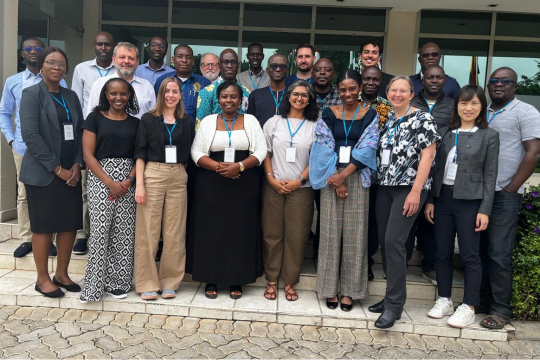
EfD's 2.5-year project on voluntary carbon markets (VCM) in the Global South is coming to an end and has generated timely and valuable insights into the challenges and potential of VCM to reduce carbon emissions while channeling finance for climate action. Researchers, carbon market experts, and policy representatives participated in a final international workshop on June 4-5 to validate findings and chart the path forward.
Demand for high-quality carbon credits and the operationalization of Article 6 of the Paris Agreement have increased the focus on the development of VCM, particularly in Africa.
EfD's project Exploring the Potential and Challenges of Voluntary Carbon Market in the Global South, funded by International Development Research Centre (IDRC), spanning six countries — Kenya, Ghana, Nigeria, Rwanda, Morocco, Côte d'Ivoire, and the ECOWAS region, set out to examine this development through the lens of actors, institutions, and community impacts.
Timely evidence
Dr. Kathryn Touré, IDRC's Regional Director for Eastern and Southern Africa, underscored the timeliness of the project as carbon market discussions in Africa gain momentum, most recently at the Africa Climate Talks in Addis Ababa, Ethiopia. She also signaled the COP32, to be held in Addis Ababa in 2027, as a key dissemination destination for the project's findings.
Discussions on both days validated the power-benefit dynamics of actors within the ecosystem, institutional readiness of the countries, and nature of impacts over different carbon credit project types (afforestation/reforestation, clean cookstoves, renewable energy, etc.).
Very diverse landscape of VCM
This reflected the diverse landscape of VCM activities across the case countries, drawing on the project's extensive stakeholder consultations with over 125 key actors engaged across the market.
Several themes emerged across discussions: how benefit-sharing arrangements work and their enforcement in practice, the impact of domestically owned/led projects compared to those operated by international actors, the optimal sectoral standards to ensure quality credits, integrating Article 6 into national carbon market frameworks, and the influence of buyer preferences on project types in Africa.
Top priority: benefit-sharing
The forward-looking horizon scan identified emerging trends and potential disruptions in the carbon market landscape and discussed how localized applied research can strengthen carbon market implementation in ways that deliver both climate and local co-benefits. Benefit sharing emerged as a top priority across discussions – to address market integrity and equity.
The workshop concluded by clarifying the remaining project deliverables and dissemination plans for the outputs, with country teams from Kenya and Nigeria sharing concrete opportunities for policy engagement at the national level. The project team also outlined plans for a high-profile international side-event at COP 32 in Addis Ababa in 2027.
By: Anjali Ramakrishnan/Petra Hansson