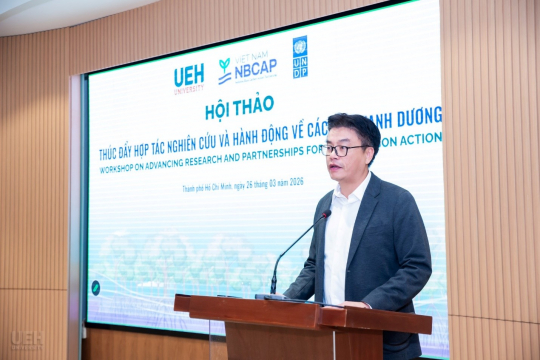
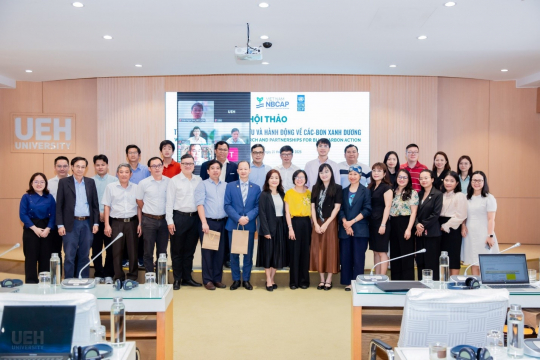
A full-day workshop on blue carbon at the University of Economics Ho Chi Minh City (UEH) brought together around 40 researchers, policymakers, business representatives, and technical experts in person and online. With over 3,200 kilometers of coastline and approximately 200,000 hectares of mangrove forests, Vietnam holds significant potential for blue carbon development. These ecosystems that not only absorb and store carbon but also protect coastlines, support biodiversity, and provide livelihoods for coastal communities.
The workshop, titled "Advancing Research and Partnerships for Blue Carbon Action", was co-organized by EfD Vietnam and the Economy and Environment Partnership for Southeast Asia (EEPSEA) at UEH and UNDP Viet Nam under the National Blue Carbon Action Partnership (NBCAP) framework, with the participation and support of the Ho Chi Minh City Green Business Association (HGBA). It took place on March 26.
Opening remarks were delivered by Associate Professor Pham Khanh Nam, Director of EEPSEA and EfD Vietnam, and Ms. Le Van Son, Program Management Specialist at UNDP Viet Nam.
Vietnam officially launched NBCAP in January 2026, becoming the third country after Indonesia and the Philippines to join the global Blue Carbon Action Partnership initiated by the World Economic Forum.
Research findings: what we know, and what we do not
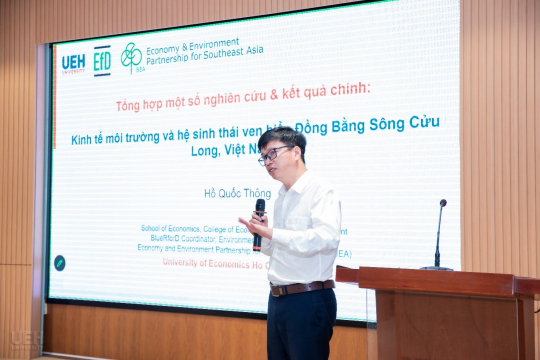
The morning sessions brought together a strong set of scientific presentations. Dr. Ho Quoc Thong, coordinator of the BlueRforD initiative under the EfD network, presented research on coastal ecosystems in the Mekong Delta. The total ecosystem value of Mekong Delta mangroves was estimated at 126.7 million USD in 2017, declining from 138.3 million USD in 1997 — a loss closely linked to land conversion for aquaculture and agriculture.
Professor Pham Thu Thuy (Flinders University, Australia) and Associate Professor Tang Thi Kim Hong (Nong Lam University), representing a research alliance connecting Flinders University, Nong Lam University, and UEH, provided a review of Vietnam's blue carbon research landscape. Their presentation clearly identified what has been done — carbon stock assessments and Monitoring, Reporting, and Verification (MRV) methodology for mangroves and seagrass — and what remains largely absent: research on tidal marshes, peat ecosystems, urban blue carbon, and capacity building at all levels.
Dr. Doan Van Cong from the LOTUS Mekong Center at Tra Vinh University contributed field evidence showing that the Mekong Delta holds carbon stocks of 478.4 tons of carbon in tidal marsh ecosystems alone, and that the net benefit of Ca Mau mangroves reaches 1,692.5 USD per hectare per year. Between 1995 and 2019, mangrove cover declined by a net 7.3 percent, with emission factors from mangrove loss estimated at 20.2 tons of CO₂ per hectare per year.
Dr. Nguyen Phuong Nam, Vice President of HGBA, presented the perspective of the business community, emphasizing that while commercial interest in blue carbon is growing, practical barriers remain: no regulations yet on carbon credit ownership or profit-sharing, and foreign investment restrictions in the forestry sector that limit capital mobilization.
Three task forces to carry the work forward
The afternoon session, led by Dr. Nguyen Sy Linh, UNDP Consultant, focused on the operational structure of NBCAP. Participants reached an agreement on establishing three thematic task forces: Policy and Governance; Science and Technology; and Finance and Market Development. Each task force will have a leader, a co-leader, and eight to twelve core members, with coordination support from the NBCAP Secretariat. Several participants expressed early interest in joining, and the first round of activities, including at least four group meetings and the production of policy briefs and factsheets, is planned for 2026.
As one of the academic co-hosts of this workshop, EEPSEA and EfD Vietnam are committed to contributing to the science and knowledge agenda that these task forces will require, and to ensuring that economic evidence remains a central part of how Vietnam develops its blue carbon strategy in the years ahead.