
As economies continue to grow around the world, many societies are simultaneously facing rising inequality, environmental degradation, climate vulnerability, and declining public trust. A newly launched United Nations report argues that Gross Domestic Product (GDP) alone can no longer fully capture whether people’s lives are actually improving — and proposes a new global framework to measure what truly matters.
On 7 May 2026, the United Nations officially launched the report “Counting What Counts: A Compass of Progress for People and Planet”, introducing the first global blueprint for measuring progress beyond GDP. Developed by the UN High-Level Expert Group on Beyond GDP, the report proposes a practical dashboard of 31 indicators designed to complement GDP and provide a broader picture of wellbeing, inclusion, sustainability, and resilience.
The launch marked the beginning of a new intergovernmental process under the UN General Assembly, following commitments made in the Pact for the Future. The initiative reflects growing international recognition that traditional economic indicators alone are insufficient for guiding policy in a world increasingly shaped by climate risks, social inequality, and rapid technological change.
A new “dashboard” for measuring progress
Speaking at the launch event, UN Secretary-General António Guterres emphasized that GDP was never intended to be the sole measure of societal success. While GDP captures economic output, it overlooks critical dimensions such as unpaid care work, environmental losses, social cohesion, and human wellbeing.

The report does not reject GDP. Instead, it proposes a more balanced framework that combines economic indicators with measures related to health, education, inequality, environmental quality, institutional trust, and resilience. The proposed dashboard is organized around four pillars: current wellbeing, equity and inclusion, sustainability and resilience, and foundational principles including peace, human rights, and respect for the planet.
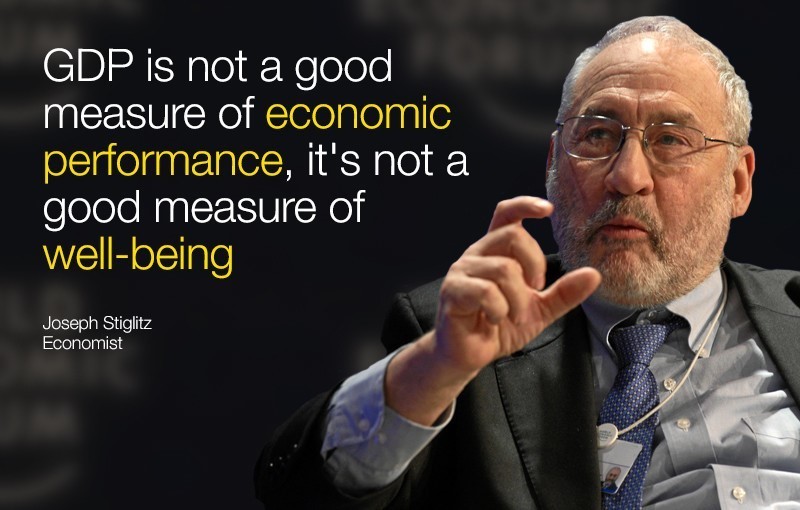
Photo source: World Economic Forum
Importantly, nearly half of the indicators are already drawn from existing Sustainable Development Goal (SDG) frameworks, allowing countries to build on existing statistical systems rather than creating entirely new reporting structures.
Bringing perspectives from Vietnam and the Global South
The High-Level Expert Group (HLEG), established by the UN Secretary-General in May 2025, consists of 14 internationally recognized experts in economics, statistics, sustainability, and public policy. The group is co-chaired by economists Kaushik Basu and Nora Lustig.

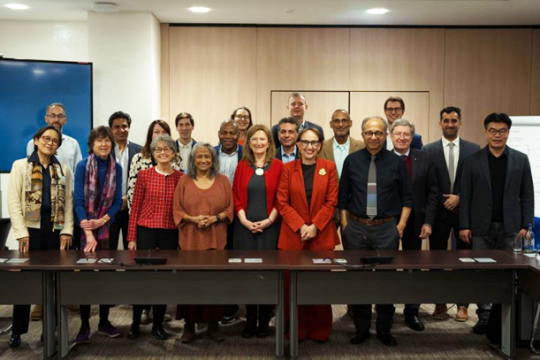
High-Level Expert Group on Beyond GDP. Source: https://www.un.org/en/beyondgdp/events
Among the members is Dr. Pham Khanh Nam, Director of EfD Vietnam. As an environmental economist, he contributed perspectives from Vietnam and the Global South to the development of the framework, particularly on issues related to natural capital, climate vulnerability, sustainability, and implementation capacity in developing countries.
“I feel both proud and a strong sense of responsibility to contribute to this important global task,” Pham Khanh Nam shared. “The discussion is not only about changing indicators, but also about rethinking how we define progress and success for societies.”
Pham Khanh Nam emphasized that developing countries bring essential perspectives to the Beyond GDP discussion. “Many countries in the Global South still face challenges related to poverty, inequality, climate vulnerability, and limited statistical capacity. Therefore, the framework must not only be ambitious, but also practical and implementable across different contexts,” he said.
Why natural capital matters
One of the report’s major contributions is the inclusion of concepts such as natural capital and planetary boundaries. According to Pham Khanh Nam, this helps shift the perception of the environment from being merely a constraint on development to becoming part of the foundation for long-term prosperity and resilience.
“Natural capital helps governments recognize that ecosystems are not just environmental assets, but also economic assets that support agriculture, energy, health, tourism, and long-term productivity,” he explained. “In the long run, damaging natural systems can create very high economic and social costs, especially for vulnerable countries in the Global South.”

One of the Beyond GDP HLEG meetings in October 2025. Photo courtesy of Pham Khanh Nam
The report also acknowledges major implementation challenges, particularly for low- and middle-income countries. Many of the proposed indicators require stronger statistical systems, better institutional coordination, and long-term investment in data infrastructure.
Pham Khanh Nam noted that implementation should remain flexible and country-owned. “Not every country needs to implement the full framework immediately,” he said. “Countries can start with indicators most relevant to their national priorities and existing statistical capacity.”
Looking toward 2027
The report outlines a roadmap toward 2027, including country pilot programs, improved statistical capacity, and the development of headline indicators that could communicate societal progress more clearly to both policymakers and the public.
Ultimately, the Beyond GDP agenda reflects a broader global conversation about what societies should value and measure in the 21st century. Rather than focusing solely on economic expansion, the new framework encourages governments to ask wider questions: Are people healthier? Are inequalities narrowing? Are natural systems being protected? Are future generations becoming more resilient?
As the report concludes, what societies choose to measure will shape what they choose to prioritize.