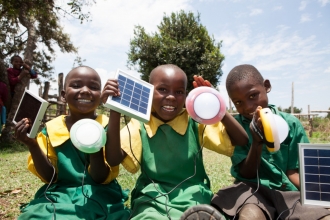
Lighting up rural Africa: How much do the poor value electricity and can they afford paying for it?
A field experiment conducted in rural Rwanda evaluates the revealed willingness to pay for different off-grid solar technologies
A field experiment conducted in rural Rwanda evaluates the revealed willingness to pay for different off-grid solar technologies
Many of us have experienced the frustration of idling in long lines of traffic, inching forward at what seems like an interminable rate. Unfortunately, traffic congestion like this is a daily occurrence in many of the world’s fastest growing cities, such as Mexico City, Bangkok, Istanbul, and Rio de Janeiro.
If you’re looking to replace your washing machine, have no fear: at least one major retailer stocks six different types of washers, with eight different sets of features, from nine different brands.
Do you like high-capacity front-loading washers? Perhaps you want your washer to also function as a dryer? Or a steamer? You’re covered!
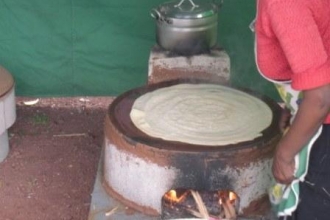
About 40% of the human population, or about 2.8 billion people, find commercial fuels like electricity and gas inaccessible, too expensive or too irregularly supplied to use for cooking and heating (Smith et al., 2013; IEA, 2012). Instead, they rely on solid fuels like coal, fuelwood, dung and charcoal that are combusted inside their homes.
Kailin Kroetz, James N. Sanchirico, Julio Peña Torres, David Corderi Novoa
Why are economists, like lawyers and proctologists, universally loved and admired? One reason is our penchant for highlighting the perverse unintended consequences of public policies, particularly policies that ignore behavioral responses.
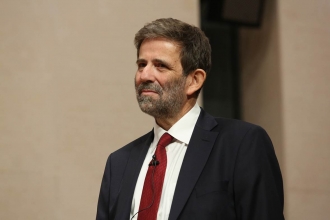
A few weeks can pass quickly in politics. A moment ago Francois Hollande sat and discussed climate science at the College de France.

Today I was feeling confident that I had my badge and knew my way around the COP21. In the afternoon I was first working with two colleagues from Gothenburg (Åsa Löfgren and Wolfgang Habla). Then I was at the Ecole de Mines – one of the great engineering schools.
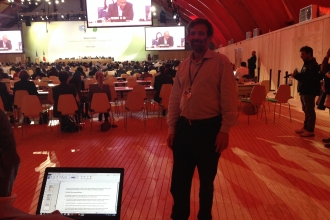
First day we travelled to Le Bourget. Åsa Löfgren and I and many thousands more. People from small island states, in national costumes of feathers and many men in suits. Then dozens of scanners and badges, welcome packages and everything just magically swift. All in all the arrangements, the scanning, the process of registration for accredited observers, absolutely everything has worked smoothly. Much better than in Copenhagen.
Yesterday Noveber 30th, COP21 was finally inaugurated by President Hollande. Of course it is hard in such a speech to know what are just words and to what extent there will be force behind them. Clearly he is riding on a wave of some sympathy. Two weeks ago he came and shook hands with me and those next to me in the front row, after spending a few hours debating at the Collège de France. He said he wanted to speak not only for France but for Science. Then came the terrorist attacks and he was propelled into his role as the strong leader of France.