In many parts of the world, climate change is no longer a distant threat—it is already reshaping everyday life. Rising temperatures are affecting health, productivity, and livelihoods. Less visible, but equally concerning, is their impact on learning—especially for very young children.
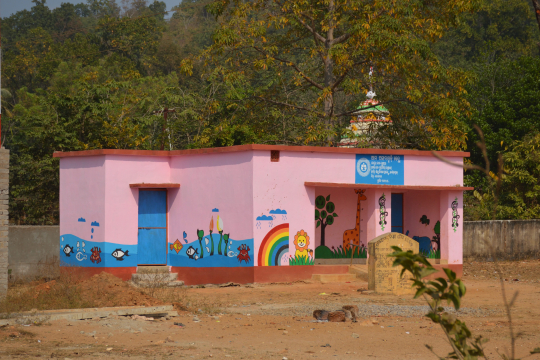
In India, millions of children attend government-run pre-schools known as anganwadis. These centers are the backbone of the country’s Integrated Child Development Services (ICDS), providing early education, nutrition, and health support. Yet most anganwadis operate in small, single-room buildings with tin or concrete roofs, limited ventilation, and no cooling. During hot months, indoor temperatures can soar—right when children are expected to learn, play, and concentrate.
Can a simple, low-cost change to the physical environment help?
Our recent randomized controlled trial in the Indian state of Kerala suggests that it can. By painting pre-school roofs white with a high-reflective “cool roof” coating, we reduced indoor heat and improved children’s cognitive performance—at a cost of roughly Rupee 1 (about USD 0.01) per child per day.
Children are more vulnerable
A growing body of evidence shows that high temperatures impair cognitive performance, reduce attention, and worsen learning outcomes. While most studies focus on older students or exam performance, early childhood may be especially vulnerable. Young children have lower thermal tolerance than adults, and early cognitive skills form the foundation for future learning.
Yet adaptation in early learning environments has received little attention. Air-conditioning is expensive, energy-intensive, and often infeasible in low-resource public settings. This makes passive, low-cost alternatives particularly attractive.
The intervention: a simple coat of white paint
Working with the Energy Management Centre (EMC) of the Government of Kerala, we evaluated a cool roof intervention in 73 anganwadis across five panchayats (a unit of local self-government) in Thiruvananthapuram district.
Eligible pre-schools were randomly assigned to treatment or control groups. In treatment centers, roofs were coated with a high-albedo white paint designed to reflect sunlight and reduce heat absorption. The intervention was completed just before the peak summer months of 2024, one of the hottest years on record in Kerala.
Measurably cooler classrooms
Indoor temperatures in treated pre-schools fell by about 1.3°C relative to control centers. Thermal imaging revealed the mechanism clearly: treated roofs were roughly 11°C cooler, and ceilings about 5°C cooler, than untreated ones. Less heat entered the classroom, lowering the thermal burden throughout the day.
Pre-school staff noticed the difference. Teachers and helpers in treated centers reported significantly lower heat discomfort and perceived temperatures compared to their counterparts in control schools.
Better learning outcomes
Lower heat did more than improve comfort—it translated into better learning conditions.
We measured children’s cognitive performance using a simple, age-appropriate puzzle task administered before and after the intervention. Despite the task being intentionally kept easy, children in treated pre-schools showed meaningful gains. Cognitive performance improved by roughly 6 - 7 percent relative to baseline levels.
These gains are modest in absolute terms, but important in context. Early childhood learning is cumulative: small improvements today can raise the returns to later investments in education. That a low-cost environmental change produced measurable cognitive benefits underscores how sensitive early learning environments are to heat.
Notably, we did not find an effect on attendance. This is not surprising given summer holidays in schools and extreme heatwave closures in the pre-schools during the study period. The main channel appears to improve learning conditions when children are present, rather than increased participation.
Cost-effective adaptation strategy
The cool roof intervention cost approximately 19,500 Indian rupees (about USD 216) per pre-school, including materials and labor. Spread over its expected lifespan, this amounts to around rupee 1 (USD 0.01) per child per day—far cheaper than installing and running air-conditioning, which can cost five times more per child per day and requires reliable electricity.
Compared to other routine expenditures in anganwadis, such as nutrition budgets and staff wages, cool roofs are inexpensive, easy to maintain, and scalable.
Policy lessons for climate adaptation
This study offers three broader lessons for climate and development policy.
First, heat is a human capital issue. Rising temperatures quietly erode learning, productivity, and well-being, particularly among vulnerable populations.
Second, adaptation does not always require high-tech solutions. Passive cooling technologies like cool roofs can deliver tangible benefits at very low cost, making them well-suited for public infrastructure in low and middle-income countries.
Third, early childhood settings deserve priority. Protecting learning environments during the earliest years may yield long-term returns that far exceed the modest upfront investment.
As climate change intensifies, governments will need practical, scalable tools to protect people from heat. Sometimes, one of the most effective solutions is also one of the simplest: a white roof, reflecting the sun.
This post is based on the recent working paper by the authors. Benston John & E. Somanathan & Rohini Somanathan, 2025. "When the Roof Reflects: Heat, Learning and Adaptation in Early Childhood Settings," Working papers 358, Centre for Development Economics, Delhi School of Economics.