
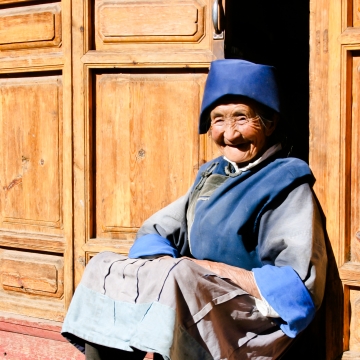
Naturally Available Pollinator Decline Will Decrease Household Food Security and Increase the Gender Gap in Nutrition between Men and Women Who Head Smallholder Farm Households in Sub-Saharan Africa
EfD Authors:
This multi-country analysis studies the food security implications of natural pollinator populations in sub-Saharan Africa, where smallholder farmers rely on wild pollinators in the absence of commercial pollination services. The study specifies daily intake of energy, macro-nutrients, minerals and vitamins per household member, and identify differences in pollinator dependence in male- and female-headed households. Four key observations emerge. First, smallholder farm households produce a menu of food crops.

Central America: Air pollution from cars costs Costa Rica millions in health care (2018)
The health cost of high air pollution from vehicles in the Costa Rican capital of San José and its immediate surrounds runs to millions of dollars each year, according to new research from the
Explaining environmental health behaviors: Evidence from rural India on the influence of discount rates
The authors examine whether high personal discount rates help explain why and which households in developing countries under-invest in seemingly low-cost options to avert environmental health threats, including bednets, clean cooking fuels, individual household latrines, water treatment and handwashing. First, the authors elicit personal discount rates by combining a simple randomized experiment with detailed surveys of over 10,000 rural households in Maharashtra, India. Personal discount rates are lower for women, for better-off households, and for households who can access formal credit.
Fifth Chilean EfD Workshop on Environmental and Natural Resource Economics and Fourth Short Course to Policy Makers
Research Nucleus in Environmental and Natural Resource Economics at the University of Concepción is organizing the Fifth Workshop on Environmental and Natural Resource Economics, 5th and 6th October…
Perceptions of caretakers with different socioeconomic status about the harmful outcomes of fever in under-five children in Dodoma region, central Tanzania: A cross-sectional study
EfD Authors:
Background:
Socioeconomic status can affect health in childhood through many different pathways. Evidence on how households differ with regard to socioeconomic status and the degree to which this difference is associated with investment in child health is essential to the design of appropriate intervention strategies.
Aim:
Greening Africa’s growing cities
Africa’s cities growth might have kicked off a bit later than many other developing world countries, but they are growing fast. This presents an opportunity to do so in a way that creates ‘a more…
|
Health |
South Africa
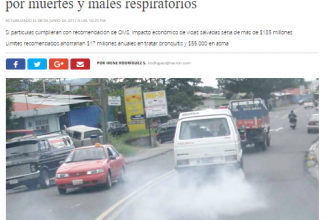
EfD Central America research on pollution and economic impact featured in national news
Research findings from EfD-CA’s research project of the economic impact of diseases caused by air pollution were featured in national media such as La Nación newspaper and television news shows. The…
Optimal health and environmental policies in a pollution-growth nexus
EfD Authors:
This paper shows how policies aimed at insuring health risks and those intended to improve the environment are (and should be) deeply intertwined. In the model economy inspired by recent Chinese experience, pollution raises the likelihood of future, poor health prompting households to save more so as to self-insure against anticipated medical expenses. Increased household saving generates more capital while capital use by firms generates more pollution.