The Impact of Forest and Non-Forest Land Cover on Potable Water Treatment Costs

Submitted by Eugenia Leon on

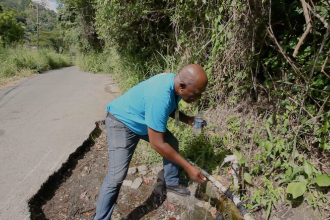
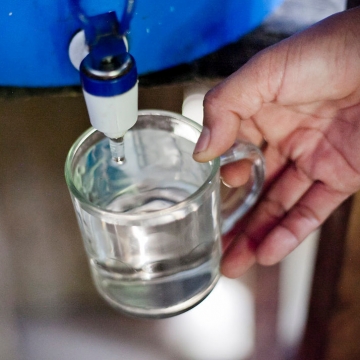
Access to clean water is one of the 17 Sustainable Development Goals (SDG) to be achieved by 2030, and a priority on the environmental policy agenda in Ethiopia. A main challenge for clean water supply utilities is how to accommodate watershed protection and management costs. The type of land cover around water sources has a notable effect on the cleanliness of the water and hence on water purifying costs.
Forestry, Water

A Decision Support Tool for Rural Water Supply Planning 20-06

Submitted by Eugenia Leon on
EfD Authors:

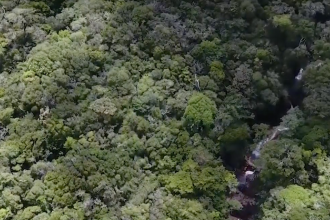
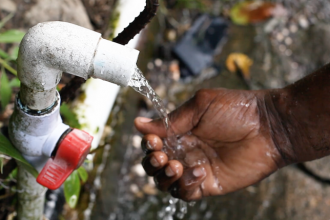
Over a dozen studies have examined how households who travel to collect water (about one quarter of humanity) make choices about where and how much to collect. There is little evidence, however, that these studies have informed rural water supply planning in anything but a qualitative way. In this note, we describe a new web-based decision support tool that planners or community members can

Policy Design, Water

Behavioral spillover effects from a social information campaign

Submitted by César Salazar on

We investigate whether a social information campaign aimed at reducing water use causes a spillover effect on the use of electricity. On average, water use decreased by 6 percent for the treatment group. We identify a positive spillover effect on electricity use among households that had efficient use of water before the campaign. The effect is sizeable: almost a 9 percent reduction. We argue that these results are consistent with a model of cognitive dissonance where the efficient households infer information about electricity use from the water use information.

Climate Change, Energy, Policy Design, Water

Impact of soil and water conservation technology adoption on smallholder farms in South-Western Uganda

Submitted by Jane Anyango on
EfD Authors:

For countries where the agricultural sector supports a majority of the population as in Uganda, the link between poverty and land degradation is of great significance. Soil and water conservation technologies are a recommended means of reducing degradation rates. However, ex-ante and ex-post analyses of the impact of these technologies remain few.

Agriculture, Conservation, Water

Any Rain on Victoria Lake Is Only a Drop in the Bucket: A CGE Analysis of the Effects of Water Shortages on Food Security in Uganda

Submitted by Jane Anyango on
EfD Authors:

Using a dynamic Computable General Equilibrium (CGE) model of Uganda, we simulate the effects of water shortages and their impact on agricultural production and the broader Ugandan economy. It is expected that Ugandan crop production will be hit hard over the next forty years by increasing temperatures and decreasing precipitation associated with climate change. We use forecasts from the literature for ten specific crop outputs to simulate the effects of weather-related agricultural disruption on the rest of the economy.

Agriculture, Climate Change, Water

Are embankments a good flood control strategy? A case study on the Kosi river

Submitted by Vidisha Chowdhury on
EfD Authors:

Whether embankments should be used to control floods is a question of great importance in the eastern Gangetic plain, where embankment breaches cause severe flood damage every year and huge damage due to major breaches every few years. Critics of the embankment policy have called for a strategy of living with floods by building dispersed infrastructure to cope with floods. However, no cost–benefit analysis of alternative strategies is available. This paper makes a first pass at evaluating embankments.

Water