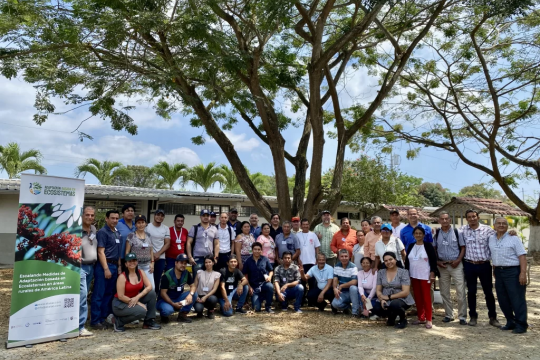
What does climate resilience look like when it starts in the hands of farmers, community leaders, and local institutions? Across Costa Rica, Guatemala, and Ecuador, an innovative program is demonstrating that ecosystem-based adaptation can be more than a traditional policy tool; it can be a force for transformation, equity, and sustainable rural development.
In response to the increasing challenges of climate change, the Scaling-up Ecosystem-based Adaptation Measures in Rural Latin America (EbA LAC) program is developing innovative methods to improve climate resilience in Ecuador, Guatemala, and Costa Rica. From 2020 to 2025, it assists governments, financial institutions, and communities in integrating ecosystem-based solutions into their adaptation efforts.
EbA LAC builds on scientific evidence and lessons learned from the Ecosystem-based Adaptation for Smallholder Subsistence and Coffee Farming Communities in Central America project (CASCADE), which was implemented from 2012 to 2018. The CASCADE project was led by Conservation International (CI) and implemented together with CATIE (host institution of EfD Central America and Mexico) and the French Agricultural Research Centre for International Development. CASCADE generated valuable knowledge on how ecosystem-based approaches can help vulnerable smallholder farming communities adapt to climate change.
EfD researchers active in this program are Dr. Arlene López-Sampson and Eduardo Pacay.
As a key initiative of EfD Central America and Mexico (EfD CAM), EbA LAC applies these insights and expands them in new settings, turning research into action across rural areas. To achieve meaningful outcomes, the program concentrates on four main areas: governance, implementation and scaling, climate finance, and capacity building.
Provided clear guides for action
EbA LAC has helped integrate ecosystem-based adaptation (EbA) into national and local development and land-use plans, ensuring long-term commitment to climate resilience. In Costa Rica, EbA LAC has provided technical guidance to a rural local government in developing its Local Climate Adaptation Plan.
“This plan is not just a technical document; it’s a clear guide for building a resilient and prepared local community,” said Vice Mayor Yamileth Hidalgo.
In Guatemala, EbA LAC collaborated with ministries to promote the integration of EbA’s scientific evidence. Following intersectoral dialogues, the Ministry of Agriculture (MAGA) integrated 20 EbA measures into its Annual Operating Plan, with a focus on soil and water conservation.
In Ecuador, the Manabí province has included climate and gender considerations into its Territorial Development and Land-Use Plan (PDOT).

Innovative financing mobilizes resources for adaptation
Scaling up ecosystem-based adaptation requires more than good policies; it demands smart funding. EbA LAC has pioneered innovative financial approaches that are now transforming how cooperatives, financial institutions, and rural communities invest in climate resilience.
In Costa Rica, the program partnered with two savings and credit cooperatives, COOCIQUE and COOPECAR, to pilot the combined implementation of the Environmental and Social Risk Management System (SARAS) and the Agroclimatic platform. This has enabled them to assess climate, environmental, and social risks across their agricultural loan portfolios and channel financing toward ecosystem-based adaptation measures.
“These tools give our members valuable data to make informed decisions, leading to better economic outcomes that also respect the environment,” said Nelson Salazar, commercial director at COOCIQUE.
Facilitated access to environmentally friendly technology
EbA LAC also provides seed funding and technical support for ecosystem-based adaptation actions. With this support, small rural producers have improved their infrastructure, developed composting systems, reduced their use of agrochemicals, and explored tourism potential.
“It helped us break down barriers,” said Daniel Vega, a farmer. “For rural producers like us, it’s hard to access technology and markets, but this program opened doors.”
In Ecuador, EbA LAC supported rural cooperatives to launch green credit products. Partnering with Financoop, they offer loans for nature-based projects, such as agroforestry and apiculture.
“This is more than financing—it’s about delivering knowledge and technical support to small producers,” said Financoop’s general manager, Marín Bautista.
At the community level, eight local savings groups have also been strengthened, boosting women’s leadership and financial inclusion.
“Thanks to the savings group and EbA LAC, I’ve learned how to manage money and adapt our farm to climate change,” said Digna Pastora, a rural leader. “As women, we handle household finances, and now we’re also leading community resilience.”
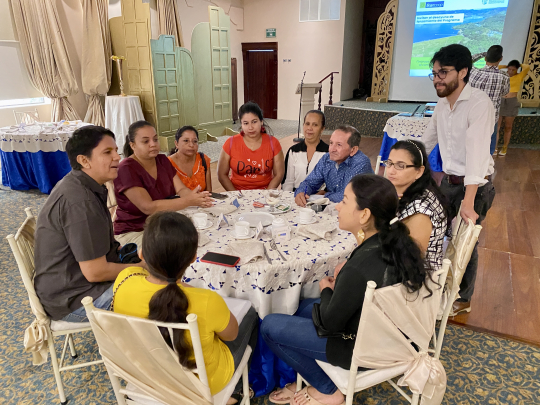
Strengthening local voices amplifies transformation
EbA LAC believes that climate adaptation is most effective when communities lead it. Through targeted capacity building, the program empowers local governments, grassroots organizations, and indigenous leaders to apply nature-based solutions to improve water supply management, such as agroforestry, native reforestation, and natural regeneration, in ways that reflect local realities and priorities. But scaling these practices requires strong and sustained local leadership.
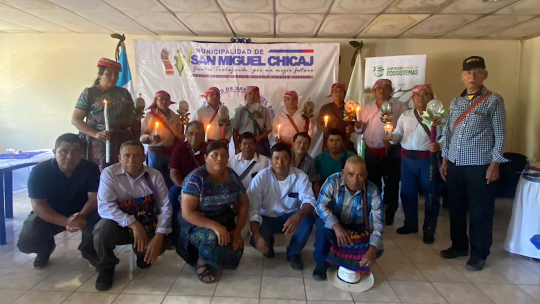
In Guatemala, for example, the program supported indigenous leaders in developing local climate adaptation action plans based on their ancestral knowledge.
“We want to be a bridge between ancestral knowledge and new solutions,” said Jesús Vásquez. “Now we can take our communities’ voices to decision-making spaces,” added Juan Lucas.
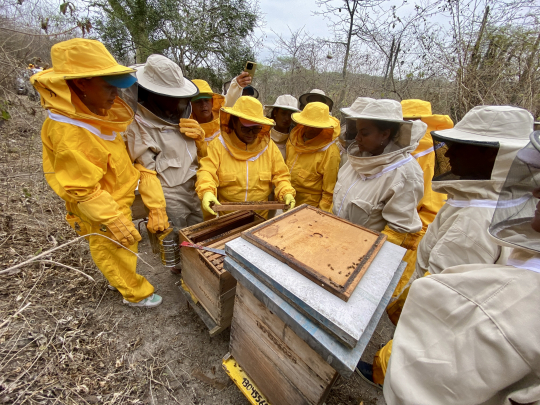
In Ecuador, producer Detsy Fernández has turned learning into action through beekeeping. “The program showed me that we will have income from honey, but we will also have a better pollination of flowers and more fruits; we will avoid fumigation and use fewer chemicals, which will be more favorable for the environment and our health,” she said. (Fumigation is the process of using chemical smoke to kill pests like insects or rodents.)
Scaling up for continuation
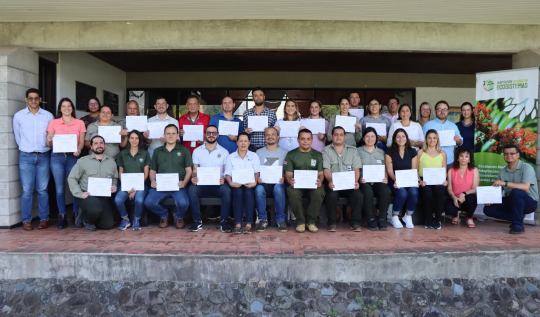
To scale their impact, EbA LAC launched the Training of Trainers Course, which has already graduated dozens of professionals from local governments, conservation areas, and rural development agencies.
“This training gave me the tools to work with farmers, women, and youth,” said Lizy Vergas of Livestock Corporation CORFOGA.
By training those who already work within communities, EbA LAC has helped build a local force of leaders who are now better prepared to teach and support others in restoring ecosystems and strengthening climate resilience from the ground up.
Tangible impacts and a pathway forward
The impacts of EbA LAC are already visible across the region. Farmers in Costa Rica are accessing climate-smart finance, rural families in Ecuador are launching ecosystem-based enterprises, and indigenous leaders in Guatemala are influencing local climate agendas.
EbA LAC’s legacy lies not only in restored ecosystems or improved policies, but in the empowered local leaders building resilience every day. That's why EfD researchers, who also lead the program, continue to monitor outcomes to guide future climate finance and policy reform across the Global South.
EbA LAC program is funded by Germany’s Federal Ministry for the Environment, Nature Conservation, Nuclear Safety and Consumer Protection (BMUV) through its International Climate Initiative (IKI) and led by the German Development Cooperation (GIZ). The initiative partners with the International Union for Conservation of Nature (IUCN) and the Tropical Agricultural Research and Higher Education Center (CATIE).
List of CASCADE-related publications.
Additionally, the EbA-LAC project has a publication page.
For more information, visit: https://ebalac.com/en/
By: Daniela Rivera