Researchers from EfD Uganda have developed a Model for Natural Capital Policy Assessment (MONCAP) that will help government agencies pursue a balanced growth that doesn’t come at the expense of forests, wetlands, biodiversity, and water resources, needed for long-term prosperity.
The MONCAP is an Excel-based tool based on macro-economic modeling, designed to include natural capital assets in national policy and fiscal planning. The user can test different scenarios and see what the outcome will be on different sectors, for instance, GDP, water access, employment, or biodiversity. If the government wants a GDP growth of 20% – how much water will be needed?
The model has been developed in close collaboration with the Ministry of Water and Environment (MWE), the Ministry of Finance, Planning and Economic Development (MoFPED), National Planning Authority (NPA), National Forestry Authority (NFA), National Environment Management Authority (NEMA), and National Water and Sewerage Corporation (NWSC). The Uganda Bureau of Statistics (UBOS) has also been part of the project, and the model is based on data from them. This broad participation paves the way for policymaking that harmonizes different sectors.
Uganda faces several challenges
This tool comes at a decisive moment for Uganda. The government aims for a tenfold growth, from a GDP of $50 billion to $500 billion by 2040, while committing to reducing greenhouse gas emissions by 25% by 2030 under the Paris Agreement. The country is severely affected by the effects of climate change, and the population is growing rapidly. In addition, UBOS data that has been analyzed through MONCAP reveals a sharp decline in wood stock between 1990 and 2015: supply dropped from 169 million tons to 69 million tons, while demand surged from 17 million to 49 million tons. This imbalance threatens both livelihoods and long-term economic stability.
“By placing a measurable value on nature, MONCAP equips policymakers with evidence to aim for sustainable growth, to ensure that Uganda’s economic ambitions don’t come at the expense of the forests, wetlands, and water resources,” explains EfD researcher Peter Babyenda.
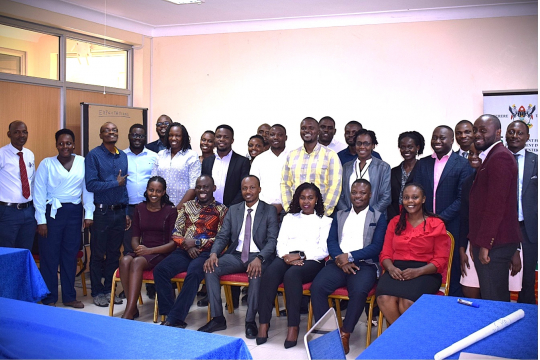
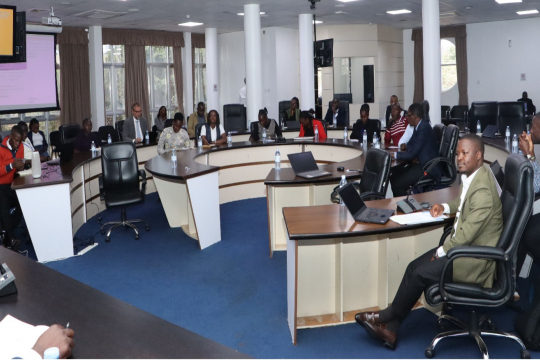
Government officials from the participating ministries have attended a number of training sessions, in all about seven days, and now have the skills to use the model to produce policy simulations, conduct scenario analysis and to motivate their project proposals.
Has impact on environment and society
Charity Kansiime, Senior Economist at the Ministry of Water and Environment, is one of the participants in the project. She describes the tool and the training as very useful.
“It helps me justify projects, for example, explain why we need the government to invest in the forest sector and support decision making,” she says.

“I can now show what the implications of investments of, for instance, 30 billion, will be on not just forestry, but on the agricultural sector, the industry, the export sector, GDP, and so on.”
She also highlights the indirect effects of being able to justify environmentally friendly projects.
“Preserving our environment has, of course, also other impacts on society, such as boosting tourism, mitigating dry spells, and much more,” she says.
One example of how she has used the tool was to justify a project submitted to the Ministry of Finance, Planning, and Economic Development, titled Integrated Forest Landscape Restoration for enhanced climate and ecosystem resilience in Uganda.
Cross-sectional learning
One important success factor of the MONCAP project, according to Charity Kansiime, is the participation of several ministries. She expects that the collaboration on NCA between EfD Uganda and the ministries will continue and be developed over the years.
“There was a lot of capacity building not only between academia and government but also across the sectors. And now, if I want to discuss issues related to this, I can easily call my colleagues at other ministries, as well as the researchers at EfD Uganda,” she says.
The EfD researchers are also looking forward to a continuation of the work on implementing Natural Capital Accounting.
“This project has been challenging but also very rewarding for us,” says Peter Babyenda.
“It has positioned us as a hub for macroeconomic modelling and NCA in Africa, and many potential partners and funders have reached out to us to hear about our work.”
The EfD researchers who have participated in this project are Edward Bbaale, Peter Babyenda, John Sseruyange, and Nick Kilimani. It was funded by Deutsche Gesellschaft für Internationale Zusammenarbeit (GIZ).
By: Petra Hansson