FILTER
Displaying 1 - 10 of 60 publications
Abstract In cities around the world, COVID-19 lockdowns have significantly improved outdoor air quality. Even if only temporary, these improvements could have longer-lasting effects by making chronic…
| Peer Reviewed | Colombia, Central America and Mexico
Developing country forests sustain livelihoods, help to control flooding, recharge aquifers, pollinate crops, cycle nutrients, harbor biodiversity, and sequester carbon. As a result, forest loss and…
| Peer Reviewed | Ethiopia, KenyaAbstract A growing set of researchers and policymakers argue, somewhat counterintuitively, that regulated timber extraction can help conserve forests in developing countries by discouraging illegal…
| Peer Reviewed | Central America and MexicoA common policy response to severe air pollution and traffic congestion in developing-country megacities is to ban the driving of vehicles with license plates ending in certain numbers on certain days…
| Peer Reviewed | ChinaAbstract Illegal land-use change inside protected areas (PAs) in the global south is common. Yet little is known about whether PAs disproportionately discourage conversion of forests to capital…
| Peer Reviewed |A Contingent Valuation Approach to Estimating Regulatory Costs: Mexico's Day Without Driving Program
Little is known about the cost of environmental regulations that target households instead of firms, partly because of significant methodological and data challenges. We use the contingent valuation…
| Peer Reviewed | Sweden, Central America and MexicoDescription Latin America and the Caribbean (LAC) region is exceptionally biodiverse. It contains about half of the world’s remaining tropical forests, nearly one-fifth of its coastal habitats, and…
| Books, EfD/RFF Book |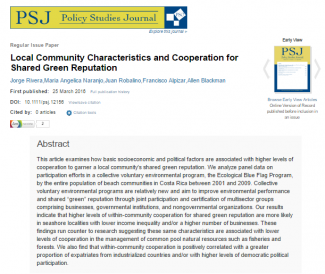
This article examines how basic socioeconomic and political factors are associated with higher levels of cooperation to garner a local community's shared green reputation. We analyze panel data on…
| Peer Reviewed | Central America and MexicoAbstract: According to advocates, eco-certification is a win–win solution to the problem of environmental degradation caused by developing country agriculture, improving both the environmental and the…
| Peer Reviewed | Central America and MexicoSince its creation more than two decades ago as a voluntary market-based approach to improving forest management, forest certification has proliferated rapidly in developing countries. Yet we know…
| EfD Discussion Paper | Central America and Mexico