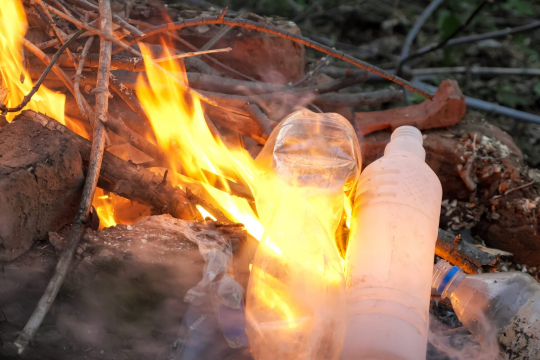
New research identified primary drivers of plastic waste burning as household fuel in 26 countries in the Global South, a widespread practice across low-income communities despite the negative effects on health and the environment.
The research paper Prevalence of plastic waste as a household fuel in low-income communities of the Global South was carried out by EfD research fellows Bishal Bharadwaj, Chizoba Obianuju Oranu, Philip Kofi Adom, Margaret Banga, Madina Guloba, Marc Jeuland, and Yacob Mulagetta, alongside a collaborative team of over 30 researchers from various disciplines and countries. This paper builds on previous research published in 2025: The use of plastic as a household fuel among the urban poor in the Global South. (Also shared as a news article).
Key drivers of plastic burning
While previously supported only by anecdotal evidence, new data show that one in three community informants is aware of households using plastic to manage waste and meet energy needs.
After surveying 1018 key informants from 26 countries, the team identified the three primary factors driving this hazardous practice. First, the massive volume of plastic waste generated by households increases the demand for garbage collection services. Second, high prices for clean energy sources, such as electricity, force families to turn to free, but toxic, alternatives. And third, many households burn plastic simply to reduce the physical piles of trash in their immediate living areas as a way to self-manage waste.
Call for waste collection and clean energy alternatives
Because this practice is most common in marginalized communities and is often hidden, it escapes the attention of policymakers and institutions. However, it represents a severe risk to people's health and the environment.
The authors call for providing reliable public trash collection for marginalized areas and subsidizing clean energy technologies to make them accessible to low-income families.
Bishal Bharadwaj noted that while the research is new, it has already shifted the conversation. The debate is no longer about whether households are burning plastic, but rather how widespread the practice is and how to stop it. To strengthen their case, the team is actively conducting household surveys in Ghana and Uganda. They hope this growing evidence will push local governments to prioritize infrastructure that eliminates the need for families to rely on toxic waste for heating and cooking.
By Belén Pulgar.