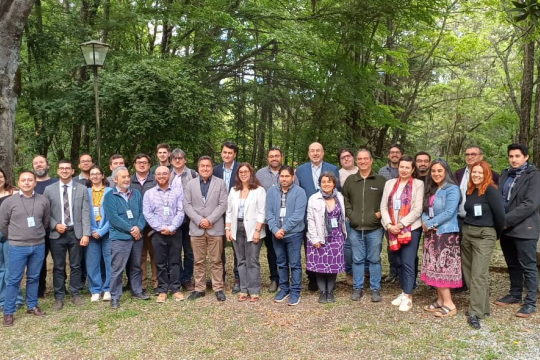
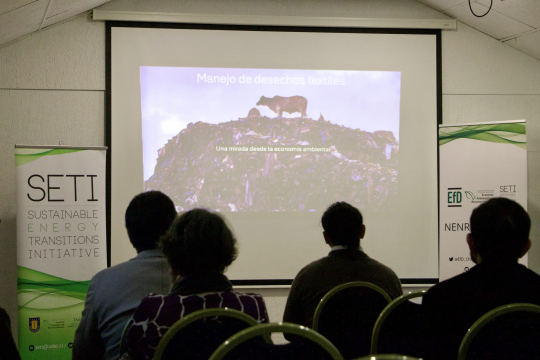
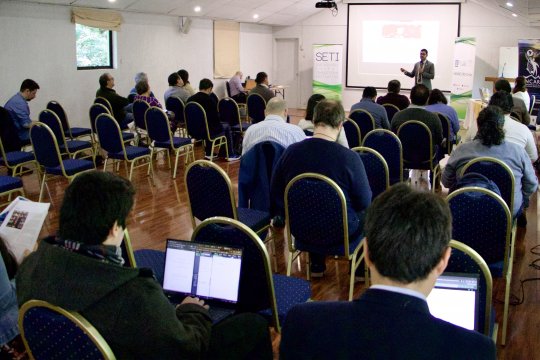
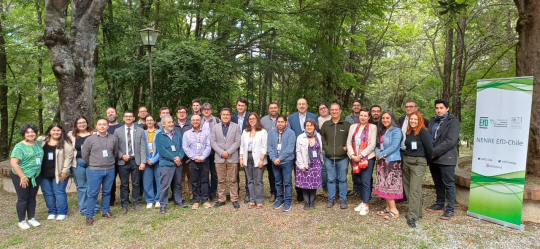
The 11th Annual Meeting of NENRE EfD-Chile brought together researchers, postgraduate students, and policymakers to analyze and discuss the main challenges and advances in applying economics to environmental issues to build better public policy on a wide range of crucial topics, such as aquaculture, waste, natural resources, and more.
Chilean farms, particularly small ones, aren't as productive as they could be. Researchers revealed significant inefficiencies in Chile's agricultural sector regarding the misallocation of resources and water scarcity adaptation, which could be improved significantly by adopting advanced technology, developing a policy focused on training leaders, and subsidizing canals and reservoirs adjusted to WUAs' (Water User Associations) typically small budgets.
Better infrastructure planning is also needed to ensure power systems are diversified and resilient to avoid being forced into a higher-pollution path during water scarcity.
Aquaculture needs better policies
There is also an urgent need to raise awareness in the salmon sector about the severe negative impacts of climate change. More sustainable technologies need to be adopted, and the government must implement policies to address and stabilize wild swings in market prices. Simply controlling the harvest of wild seaweed amounts is ineffective against unsustainable price incentives.
The Air Decontamination Plans (PDAs) and green taxes policies need to be redesigned to work more effectively and avoid negative side effects (e.g., trading one pollutant for another).
Land restitution to indigenous people has led to an increase in grasslands (traditional use) and a decrease in non-native forest plantations (timber), showing some success toward the intended goals. However, it did not lead to the recovery or loss of natural forests.
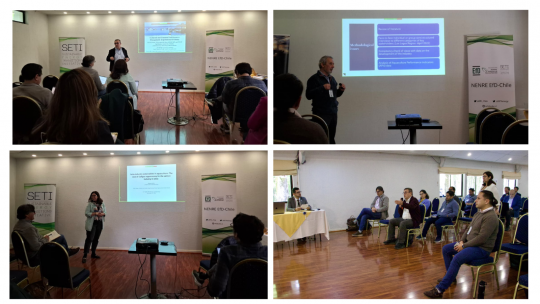
Many aspects on waste management were discussed
Waste management was discussed in a public policy panel and in several research sessions, highlighting the problem's cross-cutting nature. For example, research focused on emerging waste issues, such as marine microplastics and health, showing that atmospheric deposition of aerosolized microplastics (not seafood consumption) may be the main route of microplastic exposure during pregnancy.
Another study suggests that by understanding consumer preferences across generations on the willingness to pay for environmentally and socially impactful smartphones, companies can develop targeted approaches to balance features with sustainability attributes, thus driving more sustainable consumption behavior.
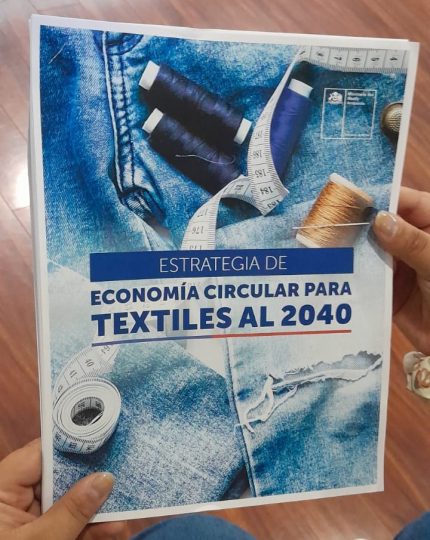
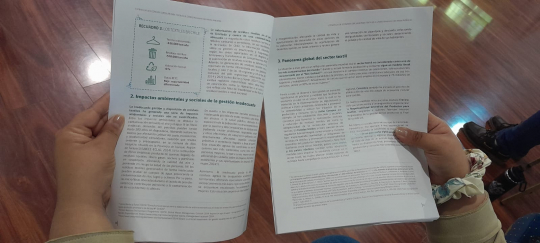
One of the highlights of the meeting was the panel on public policy, Challenges and advancement in the regulation of textile waste, a particularly urgent issue in Chile and several other parts of the world. This panel, moderated by Marcela Jaime, Director of NENRE EfD-Chile, also featured Mario Rivas (SEREMI of the Environment for the Ñuble Region), Alejandro López-Feldman (Director of Research at EfD and SCOPE fellow), and Bastián Barria (Co-founder of the NGO Desierto Vestido).
Desierto Vestido, a non-profit organization, is an initiative that brings together young people dedicated to combating textile pollution in the Tarapacá region, in northern Chile.
Marios Rivas noted that although textile waste is an emerging issue for Chilean public policy, "there are a great number of opportunities in how data is generated and how that information is interpreted, that hopefully, the productive sector can take advantage of to generate new technological solutions and promote innovation."
Strengthening research capacity
Another essential part of the meeting was the capacity building of researchers at the EfD Chile center. In these sessions, postgraduate students presented the research they are conducting to obtain their master's or doctoral degrees. These opportunities allowed them to receive direct feedback and insights from experts in similar fields, which will undoubtedly contribute significantly to the strength of their projects.
The event not only served to discuss the problems but also to foster the creation of new collaborative networks among various researchers, institutions, and NGOs. With the successful conclusion of its eleventh edition, NENRE EfD-Chile reaffirms its position in promoting applied research on environmental sustainability in Chile.
By Belén Pulgar.