Researchers from the EfD network, including members of the BlueRforD collaborative program, played an active role at the International Conference on Economics, Law and Government (ELG) 2025, hosted by UEH University on August 1–2.
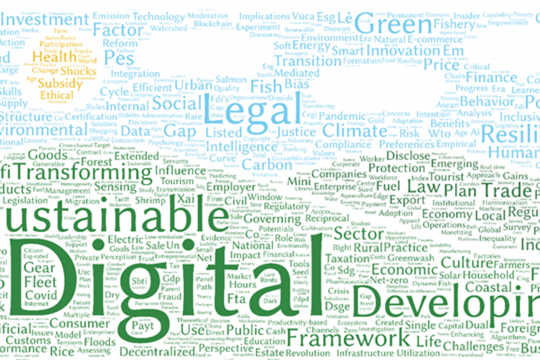
This year’s conference, themed “Resilience, Sustainability, and Digital Transformation in a Changing World: Perspectives from Southeast Asia”, brought together scholars and policymakers to discuss pressing global challenges. With 190 submissions across 32 sessions, EfD researchers stood out with keynote speakers, presenters, session chairs, and discussants, sharing evidence-based insights from across the Global South.
Keynotes highlighted climate resilience and resource governance
Two senior EfD researchers delivered keynote addresses that connected global experiences to Southeast Asia’s context.
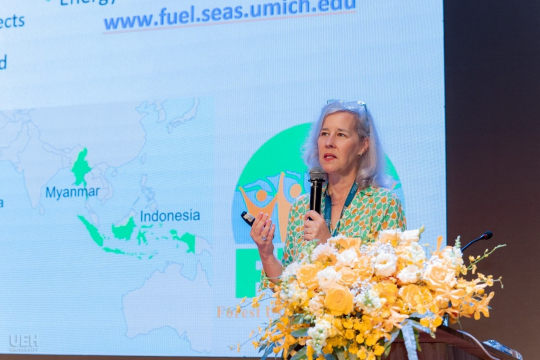
Professor Pamela Jagger (University of Michigan) introduced the concept of “climate traps”—cycles where repeated climate shocks deepen poverty and vulnerability. Drawing from her research in Malawi, she showed how ultra-poor households suffer most during cyclones, but also how interventions such as social cash transfers and early warning systems can reduce impacts.
“Poverty reduction and climate adaptation policies must work together, because neither can succeed alone,” she emphasized.
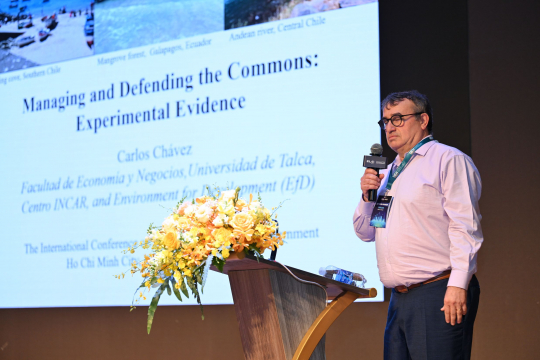
Professor Carlos Chávez (University of Talca, Chile) shared lessons from experimental economics on managing common resources like fisheries. His findings showed that local communities can successfully manage resources if they are granted rights and enforcement support. However, uncontrolled poaching undermines cooperation. Even minimal government enforcement, he noted, can significantly reduce illegal activity and support long-term sustainability.
Fisheries and aquaculture on the global agenda
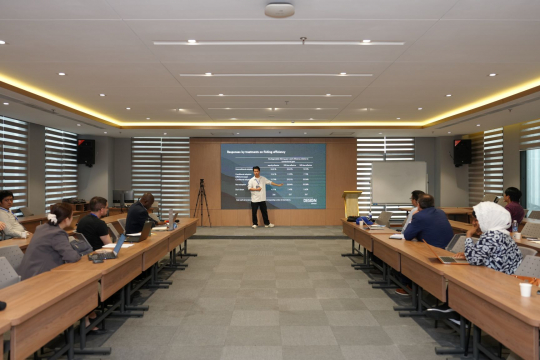
The BlueRforD program organized two thematic sessions that brought diverse perspectives on fisheries and aquaculture to the conference.
- Sustainable fisheries: Policy, markets, behavior covered topics including eco-certification impacts on salmon, ghost fishing and biodegradable gear, Vietnamese fish farmers’ adaptation to climate risks, and voting behavior on fuel subsidy removal in Ghana.
- Economic dynamics in aquaculture and marine fisheries explored the effects of fuel subsidies in the East China Sea, the rise of mussel farming in Chile, shrimp farming and social capital, energy and water poverty in Ghana, and refundable deposits to promote biodegradable gear adoption.
These sessions highlighted how fisheries and aquaculture challenges are shared across regions, from Asia to Africa to Latin America, offering valuable lessons for Southeast Asian policy debates.
BlueRforD discussed policy priorities for aquaculture
Alongside the conference, the BlueRforD core research team met to define a policy agenda for aquaculture in the Global South. Drawing on cases from Chile, Nigeria, Ghana, and Vietnam, the team identified urgent priorities such as nutrient pollution, disease prevalence, and antibiotic overuse. Proposed solutions included certification schemes, sustainable feed subsidies, pollution charges, and behavioral nudges.
EfD built bridges across regions
EfD’s strong presence at ELG 2025 demonstrated the power of collaborative, evidence-based research in shaping sustainable development policies. By connecting global perspectives with Southeast Asian challenges, EfD and BlueRforD researchers reaffirmed their commitment to bridging science and policy for a more resilient and sustainable future.
By Nhan Le