
Uganda’s push toward Climate Smart Agriculture (CSA) took center stage at a high-level annual workshop in Kampala, where researchers, policymakers, and private sector actors convened to craft solutions for strengthening resilience, productivity, and sustainability in the agricultural sector.
The meeting was organized by the EfD’s Inclusive Green Economy (IGE) program and sought to address persistent gaps between research and policy while identifying barriers that limit nationwide CSA adoption. The workshop brought together government ministries, academia, technology suppliers, civil society, and farmer representatives to chart a unified approach to building a climate-resilient agricultural system.
Agriculture at a crossroads
Speaking on behalf of the Ministry of Agriculture, Animal Industry and Fisheries (MAAIF), Emmanuel Odeng warned that Uganda’s agricultural sector, long regarded as the backbone of the economy, is now at a critical juncture. Although agriculture contributes 24% to GDP, 35% to export earnings, and employs more than 80% of Ugandans, Emmanuel Odeng noted that the sector’s contribution has steadily declined over the past decade. He attributed this trend to climate change, degraded natural resources, and insufficient investment in resilient food systems.
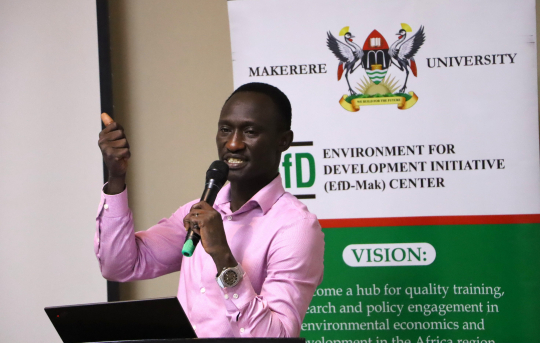
“Yields are decreasing, water sources are reducing, heat waves are rising,” he said, stressing that these pressures are pushing households back into poverty and undermining national development gains.
He emphasised the urgency of adopting CSA practices across value chains, including irrigation, agroecology, climate-resilient seed systems, mechanisation, and agroforestry. MAAIF, he said, aims to increase productivity by 40% through updated CSA compendiums and resilient value-chain investments. He challenged researchers to focus on three pressing priorities: resilience-building strategies that help farmers escape poverty, productivity-enhancing CSA technologies, and interventions to reduce post-harvest losses.
Strengthening the research–policy link
Representing the EfD Mak Centre, Dr. John Sseruyange stressed the need for stronger linkages between research and policy implementation. He noted that climate change has rapidly shifted from theoretical discussion to a daily reality for farmers, with declining soil fertility, shrinking water bodies, and recurrent shocks affecting agricultural output. “Climate change is no longer something distant; it is happening today,” Sseruyange said.
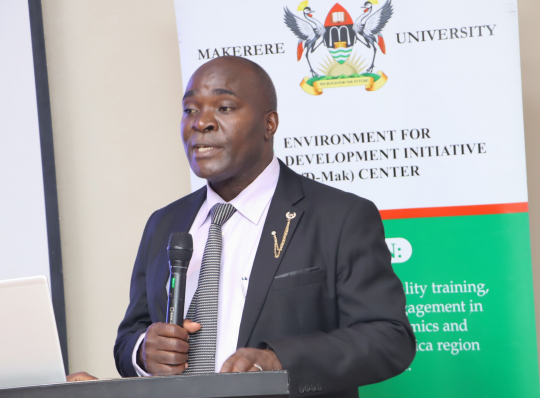
Sseruyange warned that research developed without stakeholder engagement risks remaining unused. Uganda, he argued, cannot advance CSA without research that is practical, targeted and responsive to field realities. He also presented three core questions that should guide Uganda’s CSA agenda: Which research areas can best strengthen farmer resilience? Which CSA practices most effectively boost productivity? And which strategies can reduce post-harvest losses? “When you do research without involving stakeholders, your work may remain on the shelves,” he cautioned, emphasizing the need for policy-driven collaboration.
Low CSA uptake threatens food security
Policy Engagement Specialist Dr. Peter Babyenda raised concerns about Uganda’s slow adoption of CSA practices despite mounting climate risks. “CSA offers triple wins—increased productivity, greater climate resilience, and potential mitigation,” he said, “but adoption among farmers remains very low.” Babyenda attributed this to logistical barriers, limited affordability of technologies, weak extension services, and low farmer awareness.
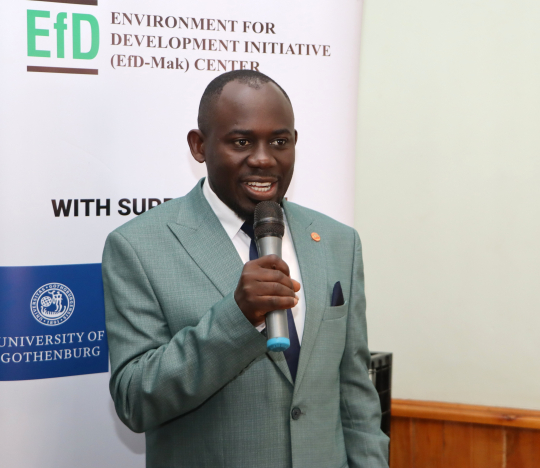
He noted that 96% of farmers rely on rain-fed agriculture, making them extremely vulnerable to climate variability. With the population growing rapidly, Uganda faces a dual challenge: increasing food production while adapting to worsening climate shocks. Babyenda stressed that CSA interventions must be localized, context-specific, and accessible to smallholder farmers. Partnerships that integrate research, technology, and farmer needs, he said, will be essential for national transformation.
“Scaling up CSA is not just desirable; it is essential for Uganda’s economic and environmental stability,” he concluded.
Tackling CSA adoption barriers through the Transformation Initiative
IGE Fellow Opeet Thomas presented a Transformation Initiative, that is, a research-based effort aimed at identifying and addressing systemic barriers that limit CSA uptake among smallholder farmers.
He explained that CSA adoption remains limited largely due to low farmer awareness, high input costs, inadequate extension services, and policy frameworks that fail to prioritise CSA innovations. Extension workers, he emphasized, are critical for disseminating CSA knowledge, yet many lack training, transportation, or institutional backing.
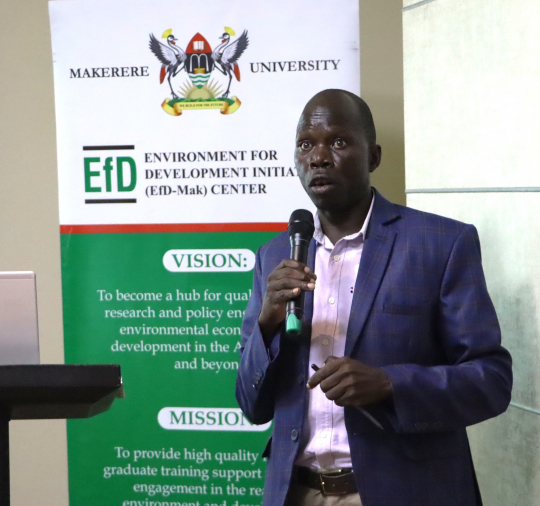
Opeet outlined a technology-adoption framework that highlights the interconnected roles of technology providers, policies, extension agents, and farmers. Even with available innovations such as irrigation systems, composting technologies, and black soldier fly applications, uptake remains low without adequate support. “The goal of the Transformation Initiative is to generate evidence that informs policy and practical interventions,” he said.
Meeting seeks solutions
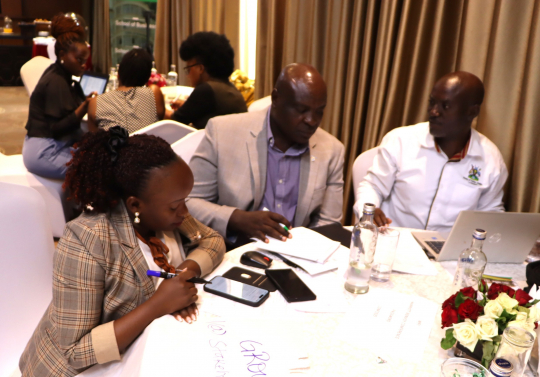
The workshop concluded with a call for stronger policy engagement, improved extension support, and enhanced collaboration across government, research institutions, and the private sector. Participants stressed that innovation, farmer engagement, and policy alignment are critical for boosting productivity and climate resilience.
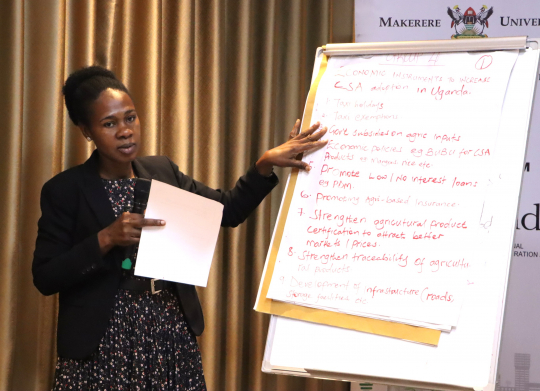
They highlighted research to strengthen farmer resilience, CSA approaches that sustainably raise productivity, and strategies to reduce post-harvest losses as national priorities. Stakeholders also emphasized the need for farmer-to-farmer extension, community-based facilitators, and better profiling of extension workers to ensure knowledge reaches remote communities. The meeting closed with renewed commitment to advancing practical, affordable CSA solutions that integrate into national policy and drive long-term agricultural transformation.
By Jane Anyango, Communication Officer