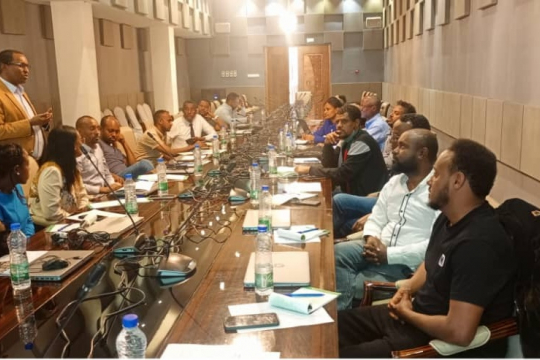
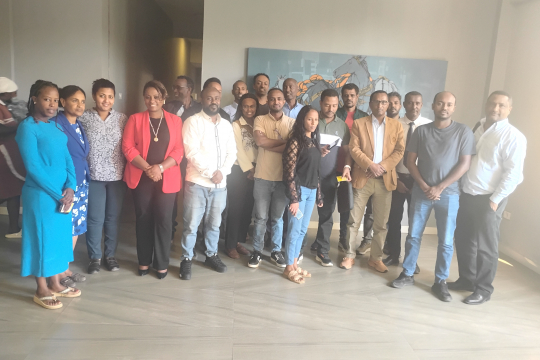
Fifteen civil servants from government institutions, working in agriculture, transport, environment, and forestry, participated in a two-day training on policy formulation and policy evaluation. They are all either current or former participants in the Inclusive Green Economy in Practice program in Ethiopia and part of the IGEP network.
Day one introduced the policy cycle, agenda setting, design, and stakeholder consultation in resource-constrained settings. Day two focused on evaluating policies, with an emphasis on impact evaluation. It provided an accessible overview of experimental and non-experimental methods, drawing on applied evidence from Ethiopia. The program reflected a growing demand across government institutions for policy processes that are both grounded in context and supported by credible measurement of results.
The training was delivered by the Environment and Climate Research Center (ECRC) at the Policy Studies Institute (PSI). The sessions were led by PSI researchers Dr. Amare Matebu and Dr. Netsanet Jote; EfD researchers Dr. Abebe D. Beyene and Dr. Zenebe G/Egziabher; and Dr. Saba Yifredew from Addis Ababa University (AAU).
Strengthening evidence across green sectors
For many participants, the sessions connected directly with their ongoing policy work. Yizengaw Yitayih, Senior Climate Change Expert at the Ministry of Transport and a 2022 IGE fellow, noted that the training came at a critical time.
“Ethiopia has already implemented a national ban on conventional gasoline vehicles, and understanding its effects on the economy, society, and the environment is essential,” he said.
“Platforms like IGEP lead to collaborations that help us study the impact of such measures. The session on scientifically selecting comparison groups for impact evaluation was very new to me and highly relevant as we revise our broader green transport policy.”
Others noted that the training helped clarify how evidence can be integrated earlier in the policy cycle.
Yamlaksira Tamene, Director for Green Technology Implementation and Monitoring at the Federal Environmental Protection Authority and a 2024 IGE fellow, emphasized that collaboration between researchers and policymakers is critical.
“We often look at changes over time, but when we do that, we may mix policy effects with other factors. The scientific approach discussed here gives us clearer insight and strengthens our work with researchers.”
Learning about scientific methods to measure impact
Abraham Tessema, a 2023 IGE alumnus and Social Safeguard Expert at the Ministry of Water and Energy, highlighted the practical value of the training:
“The full cycle, from agenda setting to evaluation, was extremely helpful. We are extending water supply and sanitation projects in 22 towns. When we draft terms of reference for consultants, these concepts help us design clearer expectations. The discussions on causation were eye-opening.”
For others, the training reinforced how evaluation supports decision-making. Tesfanesh Ababu, current IGE fellow and coordinator at Ethiopian Forestry Development, said the methods are directly relevant to the agency’s work.
“Interventions like Participatory Forest Management (PFM) and restoration initiatives need rigorous evaluation for better results. We frequently work on sampling and design issues toward impact assessment. Learning about scientific methods to measure real impact was impressive.”
The participants agreed that the IGEP network should continue to offer demand-driven training that responds to policy realities across sectors. Many noted that Ethiopia’s green transition will increasingly rely on policies that are informed by reliable data, tested methods, and closer collaboration between researchers and government institutions.
By: Saba Yifredew