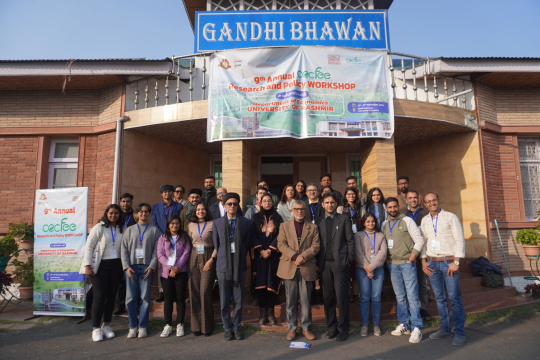
Two days of rigorous, policy-relevant research at the University of Kashmir spotlight new evidence on climate resilience, energy transition, gender, and human development in India and beyond.
The 9th Annual Workshop of the Centre for Research on the Economics of Climate, Food, Energy and Environment (CECFEE), hosted at the University of Kashmir, convened researchers working at the intersection of climate change, development, gender, and public policy. Across two days, participants presented rigorous, policy-relevant research using diverse methods—from randomized controlled trials and quasi-experimental designs to geospatial analysis and statistical modelling—reflecting CECFEE’s continued emphasis on linking research to real-world solutions.
The workshop opened with a keynote address by E. Somanathan, Professor & Head, CECFEE, Indian Statistical Institute (ISI), Delhi, who reflected on his research journey and offered guidance to early-career scholars on building credible and impactful academic work.
Climate change, adaptation & environmental resilience
Research in this session examined both local adaptation and global mitigation. Anshuman Tiwari, Post-Doctoral Fellow at the Energy Policy Institute, University of Chicago–India, showed that rapid and sustained emissions reductions can substantially reduce global mortality, with disproportionately large gains for low- and middle-income countries—underscoring the equity case for early climate action.
Complementing this, Ananta Bhushan, a student of Economics at Ashoka University, demonstrated that Indian districts historically exposed to severe drought exhibit greater long-run structural transformation and resilience today. While contemporary droughts reduce economic activity, their adverse effects are smaller in historically drought-prone districts, suggesting that repeated exposure can induce adaptive economic change.
Climate policy, energy transition & carbon markets
This session focused on the institutional design of climate policy in India. Anu K. Jose, Ph.D. Scholar at the Indian Institute of Science Education and Research (IISER), Bhopal, presented evidence that India’s Carbon Credit Trading Scheme (CCTS) has led to significant reductions in emission intensity among regulated firms, particularly from coal-based sources—highlighting the power of credible policy signals.
Priyanka Dutta, Ph.D. Scholar at the Indian Statistical Institute (ISI), Delhi, examined capital subsidies under Phase II of the Jawaharlal Nehru National Solar Mission. Her findings show that Viability Gap Funding reduced effective solar tariffs and accelerated capacity addition, while raising important questions about market concentration and design trade-offs in scaling the energy transition.
Behavioral interventions & experimental evidence
This session presented field-based evidence on behavioural and institutional change. Smit Sahebrao Gade, Director of Data and Research at Good Business Labs Foundation, analysed coordination challenges among women job-seekers in urban India, showing how collective mechanisms can improve labour market outcomes.
Shivani Wadehra, Associate Professor at Bennett University, evaluated reminders to encourage household waste sorting, finding significant improvements in sorting behaviour alongside heterogeneous welfare effects. Anshika Mathur, Ph.D. Scholar at Shiv Nadar Institute of Eminence, examined the impact of broadband availability on sexual assault in India, illustrating how digital connectivity can reshape reporting patterns and institutional responses.
Climate, development & social well-being
This session explored how climate change interacts with broader development outcomes. Naveen Kumar, Ph.D., a scholar at the Delhi School of Economics, quantified the heterogeneous impacts of climate change on well-being beyond GDP, emphasising distributional consequences across regions and population groups.
Soumya Pal, Assistant Professor at Krea University, presented evidence from India’s dairy sector showing that enterprise promotion increased incomes but had uneven effects on women’s empowerment. Anushree Khatri, Ph.D. Scholar at Shiv Nadar Institute of Eminence, examined how temperature shocks affect time use in India, revealing gendered reallocations of labour and household responsibilities.
Gender, violence & human development
Research in this session examined the links between social norms, violence, and long-term human capital. Gaurav Dhamija, Assistant Professor at IIT Hyderabad, studied attitudes toward intimate partner violence, identifying socio-economic and institutional factors that shape women’s perceptions and vulnerability.
Noyel Sebastian, Ph.D. Scholar at Jawaharlal Nehru University (JNU), Delhi, analysed the effects of spousal violence on child malnutrition, demonstrating the intergenerational consequences of domestic conflict for human development outcomes.
Air Quality & Agriculture
The final session highlighted environmental risks affecting children and farmers. Kanishka Kacker, Assistant Professor at ISI Delhi, presented findings from a randomized controlled trial in Delhi schools comparing behavioural information campaigns with HEPA air purifiers. Both interventions reduced classroom pollution; purifiers improved cognition, while behavioural strategies strengthened lung capacity—illustrating complementary approaches to protecting human capital.
Kaushik Jana, Assistant Professor at ISI Delhi, developed a statistical framework to estimate agronomic monsoon onset in South Bengal using over a century of rainfall data. By defining onset in terms relevant to crop decisions, the study provides a policy-relevant tool for farmers and finds no evidence of a progressively delayed monsoon over time.
Building knowledge for a changing climate
Taken together, the papers presented at the workshop underscore the importance of grounding climate and development policy in rigorous empirical evidence. Whether examining adaptation to drought, the design of carbon markets, behavioural change, or the social consequences of environmental risk, each contribution highlighted the need for careful measurement, institutional insight, and attention to distributional impacts.
By convening scholars across institutions and disciplines, the CECFEE Annual Workshop continues to strengthen the bridge between research and policy. In doing so, it reinforces a shared commitment to advancing solutions that are not only economically sound, but also equitable and responsive to the realities of climate and development in India.