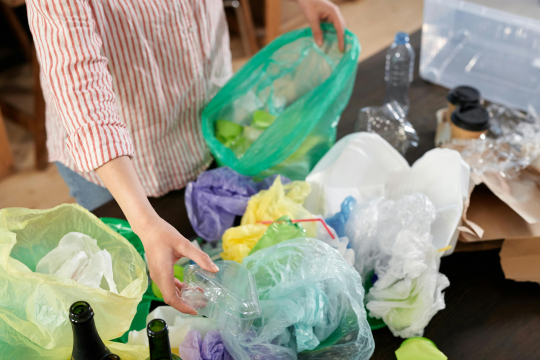
In late 2025, major global food and consumer goods producers—including PepsiCo, Nestlé, Coca-Cola, Procter & Gamble, and Unilever —met in Europe to discuss the future of packaging[1]. The summit focused on new ideas to make packaging more sustainable and reduce waste. However, one important issue remains unclear: did the event incorporate the voices and concerns of countries in the Global South? While the discussions showed progress on technical solutions, we don’t know whether the specific challenges faced by lower-income regions were truly considered—or possibly left out.
These companies are major global producers, ranking among the world’s top 10 by annual revenue. Therefore, their decisions directly affect a critical global concern: nearly 40% of all plastic waste comes from packaging, most of it linked to the food industry. For example, in the United States, packaging generates about 37% of plastic waste, compared with 38% in Europe and 45% in China (OECD 2022).
While major players debate high-level solutions regarding packaging circularity, the impacts of packaging waste are likely to be acutely felt in the Global South, where mismanagement and inequalities exacerbate the burden. Indeed, in developed countries, waste management infrastructure is generally advanced, with well-established systems for automated waste separation, curbside collection, recycling, composting, and energy recovery through incineration (Awino and Apitz 2024). By contrast, in the Global South, rapid urban growth, limited resources, and weak regulations hinder effective waste management. Public services often fall short, while informal workers contribute significantly to recycling but remain outside formal systems (Anshassi and Townsend 2025; Gutberlet 2023). This leads to negative impacts (externalities), including environmental degradation and health hazards.
Moreover, the estimates mentioned above are based mainly on data from countries in the Global North (i.e., OECD members and China), while waste mismanagement is a global concern that remains insufficiently understood in developing and emerging economies. To address this potential bias, EfD-CAM/SCOPE has sought to shed light on the issue through novel research conducted in Costa Rica, offering potential lessons for developing and emerging economies that confront similar challenges.[2]
Negative externalities of plastic waste mismanagement
First, let us clarify what a “negative externality” is and how this concept applies to waste management, including plastics and other residues. A negative externality occurs when the consumption or production choices made by an individual, firm, or government harm others without any compensation. For example, improper disposal of plastic waste causes pollution in cities, rivers, and oceans, among other places. This pollution can result in a wide range of harmful, sometimes long-lasting and unpredictable effects on human health and the environment. These unintended impacts are referred to as negative externalities.
Clogged drainage systems, pollution of beaches and rivers, harm to wildlife (e.g., marine life), microplastic contamination in food chains, and impacts on tourism are all examples of negative externalities caused by the mismanagement of plastic. A publication by CATIE/SCOPE and UNDP has addressed and attempted to quantify some of these effects in Costa Rica (United Nations Development Programme 2025), applying methodologies commonly used in global assessments (Beaumont et al. 2019; DeWit et al. 2021; Geyer et al. 2017). However, at this point, it was important to take a step back and look at the issue from a more everyday angle: how much plastic are we actually consuming and potentially mismanaging? To answer this, the team at EfD CAM (CATIE)/SCOPE undertook an eye-opening, yet simple, exercise: we went to the supermarket.
From shelf to bin: Tracing plastic in everyday purchases
To better understand the amount of plastic that ends up in our homes, the research team visited a local supermarket to purchase a sample of items from the official basic consumption basket, including packaged foods, cleaning products, and toiletries. Each product was weighed both with and without its packaging to determine the percentage of its total weight that was plastic. When packages were made of several layers (like Tetra Pak containers), typical values from previous studies were used to estimate the plastic share.
Every piece of packaging was also classified according to the standard plastic identification codes (e.g., PET, PEAD, PP, etc.). This helped distinguish between more recyclable plastics (like PET or PEAD) and those that are harder to recycle (like PVC or PS). When labels were missing, a simple visual and tactile inspection was used to identify the type of plastic based on features such as transparency, rigidity, or texture.
Once all products were analyzed, the plastic content data was combined with information from the 2018 National Household Income and Expenditure Survey (ENIGH). This allowed researchers to estimate the total amount of plastic associated with what Costa Rican families consume and how it varies by income level.
By doing these on-the-ground measurements, the team brought empirical precision to a topic often discussed in broad terms. This local, data-driven approach bridges the gap between global estimates and the daily realities of Costa Rican households, offering a concrete basis for understanding where plastic use begins and not just where it ends up.
The plastic footprint of daily life
Our results show, for the first time, that Costa Ricans generate about 242 grams of plastic per person each month from essential goods such as food and personal care products—around 751 grams per household. When scaled nationally, this amounts to nearly 14,000 tons of plastic waste per year. While it is well known that these products are sold in plastic packaging, what is new here is the precise estimate of how much this adds up to, highlighting the significant weight of everyday consumption.
Plastic dominates food and beverage packaging at 47%, followed by laminated materials, metals, and cardboard. In hygiene products, its presence is even more prominent — on average, plastic makes up 11.7% of the total weight, compared to 1.6% in foods. This emphasizes the large amount of invisible plastic connected to everyday personal care routines, often in products seen as less wasteful.
Everyday products, such as soft drinks, cooking oil, rice, and milk, generate a significant portion of the plastic waste we see each year. The main plastics in this packaging are PET, HDPE, and LDPE. PET (used in soda and water bottles) and HDPE (common in milk jugs and detergent containers) are widely recycled and can be turned into new bottles, clothing fibers, or building materials. LDPE, often found in plastic bags and wraps, is technically recyclable but less commonly collected because its thin, flexible form is more challenging to process and less valuable to recyclers.
However, not all of this generated waste is managed properly. According to national estimates, approximately 34% of plastic waste in Costa Rica is mismanaged (National Plastic Action Platform), resulting in its leakage into rivers, soil, or the ocean. This amounts to roughly 4,760 tons of plastic each year from the analyzed products alone — equal to the weight of almost 400 garbage trucks filled with discarded packaging.
These results reveal how deeply plastic is embedded in everyday consumption — even among basic goods — and show that waste generation begins well before disposal. Understanding this hidden aspect of consumption is crucial for designing effective policies that encourage sustainable packaging, inform consumers, and reduce overall reliance on plastic.
Implications & local solutions, global relevance and call to action
The evidence presented makes visible what global averages tend to obscure: the plastic challenge begins with consumption choices and the packaging of basic goods, not merely with their disposal. Plastics are the dominant material across all product categories, particularly in hygiene products, where cost and functionality often outweigh sustainability. Even in a country as Costa Rica, recognized for its environmental leadership and biodiversity, the simple act of grocery shopping contributes significantly to the national plastic footprint.
As major producers gather at the Sustainable Packaging Summit 2025 in Utrecht, evidence like this shows that effective solutions must consider how packaging decisions made at the global level play out in diverse national contexts, particularly where waste management systems remain under strain.
Addressing this challenge requires coordinated action. Policymakers must strengthen waste management infrastructure, enforce Extended Producer Responsibility (EPR), and promote incentives for reusable or refillable packaging. Industry actors should invest in innovation for truly sustainable materials, phase out low-recyclability plastics such as LDPE and mixed laminates, and reduce unnecessary packaging. Consumers, in turn, can play a crucial role by choosing plastic-free or recyclable alternatives and holding brands accountable for their commitments.
Ultimately, tackling plastic waste demands shared responsibility and a shift from isolated initiatives to systemic change. Studies like ours contribute to highlight the urgency of grounding global commitments in local evidence.
References
Anshassi, Malak; Townsend, Timothy G. (2025): Improving waste systems in the global south to tackle international environmental impacts. In Nat Sustain 8 (8), pp. 936–946. DOI: 10.1038/s41893-025-01607-8.
Awino, Florence Barbara; Apitz, Sabine E. (2024): Solid waste management in the context of the waste hierarchy and circular economy frameworks: An international critical review. In Integrated environmental assessment and management 20 (1), pp. 9–35. DOI: 10.1002/ieam.4774.
Beaumont, Nicola J.; Aanesen, Margrethe; Austen, Melanie C.; Börger, Tobias; Clark, James R.; Cole, Matthew et al. (2019): Global ecological, social and economic impacts of marine plastic. In Marine pollution bulletin 142, pp. 189–195.
Geyer, Roland; Jambeck, Jenna R.; Law, Kara Lavender (2017): Production, use, and fate of all plastics ever made. In American Association for the Advancement of Science, 7/19/2017. Available online at https://www.science.org/doi/full/10.1126/sciadv.1700782, checked on 8/26/2024.
Gutberlet, Jutta (2023): Global Plastic Pollution and Informal Waste Pickers. In Camb. prisms Plast., pp. 1–38. DOI: 10.1017/plc.2023.10.
[2] This initiative was a collaboration CATIE and the United Nations Development Program, through its Consumption 180 Program (https://pnud-conocimiento.cr/proyecto/consumo-180/).