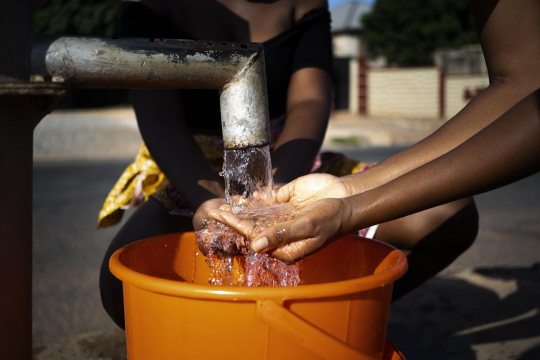
The global efforts toward improving access to safe drinking water have yielded significant results. However, low-income countries and some middle-income countries in Africa and Asia are still grappling with strategies to cope with drinking water quality. An instrumental variable approach on cross-sectional data from 1650 households is used to investigate the causal relationship between a household’s environmental knowledge and coping behaviour for improvement in the quality of drinking water. The study finds that 90% of the sample engages in coping behaviours to improve household water quality before use . Further, the study shows that environmental knowledge is a precursor to household coping behaviour with domestic water use. The study highlights demographic factors, household water characteristics, and economic and behavioural influences as additional drivers of coping behaviour. The study shows that in low- and middle-income settings, coping behaviours play a crucial role in preventing domestic water-related diseases and deaths arising from polluted environments.
Unlocking the path to improved domestic water use: how environmental knowledge shapes household coping behaviour
EfD Authors

Country
Sustainable Development Goals

Publication reference
Amoah, A., Kwablah, E., Tuffour, M., & Ngala, C. (2025). Unlocking the path to improved domestic water use: how environmental knowledge shapes household coping behaviour. Urban Water Journal, 1–19. https://doi.org/10.1080/1573062x.2025.2543432