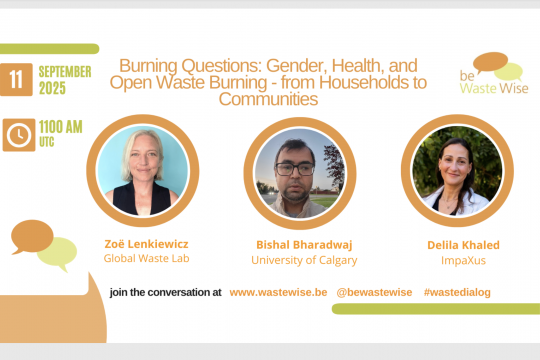
The webinar Burning Questions: Gender, Health, and Open Waste Burning – from Households to Communities explored the intersection between energy poverty, failed waste management, and gender inequality, as well as practical pathways toward inclusive solutions. Bishal Bharadwaj, EfD international associate and SETI fellow, participated alongside Delila Khaled (Principal of ImpaXus) and Zoë Lenkiewicz (Director at the Global Waste Lab),
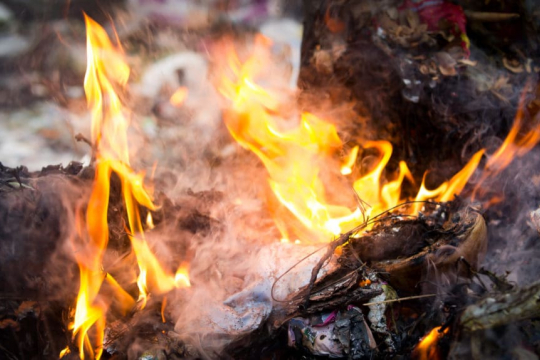
Waste burning is a practice that spans the entire continents of Africa, Asia, and Latin America, with evidence from Nigeria to Nepal to the Dominican Republic. Between 40-65% of municipal solid waste in low and middle-income countries is openly burned, affecting billions of people. Still, people believe that burning plastic is better than letting waste accumulate and create a public health hazard, while it actually creates far worse pollution.
Many reasons for burning plastics
Energy poverty affects 2.8 billion people globally. For those, burning plastic as household fuel represents a quick solution. Additionally, plastic production is expected to triple in size by 2060 while urbanization accelerates.
There are many reasons for burning plastic waste: Lack of collection services, preventing mosquito breeding and vermin, privacy concerns around bathroom waste (since burning it provides quick disposal), and the need for cheap fuel for cooking and heating. These are all motivators for waste burning in open as well as closed spaces; however, there are many negative consequences.
Pollutants can transfer to babies
Women and girls are, traditionally, in charge of cooking in most households, making them face constant exposure to toxic fumes, even more so when using waste and plastic as fuel.
Pollutants from waste burning can also accumulate in body fat and transfer through breastmilk to babies. Also, burning plastic releases additives and cancer-causing dioxins that travel long distances.
A need for low-cost alternatives
The participants highlighted the intersectional impact; Women are disproportionately affected both by energy poverty and health problems from waste burning, which also affects their children. Since current waste and energy statistics don't capture these practices, policy responses may be inadequate. There's a need for immediate low-cost interventions while building long-term infrastructure to solve this growing problem.
The researchers shared the need for no-cost and low-cost waste management alternatives, affordable clean cooking solutions, gender and income-disaggregated research to understand better the drivers behind the practices, and community consultation and behavior change programs that provide safe spaces to discuss issues related to gender inequality.
Click here to watch the full webinar.
By Belén Pulgar.