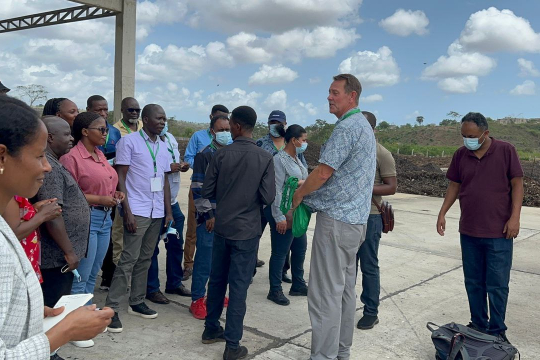
Policymakers and researchers from the Inclusive Green Economy in Practice (IGE) program and the EfD network toured the Mabwepande compost plant outside Dar es Salaam, exploring how sustainable waste management can drive climate-smart agriculture and circular economy goals.
The visit, part of this year’s IGE theme on Climate-Smart Agriculture, brought together IGE Fellows, IGE alumni, and EfD support teams for hands-on learning. The Mabwepande facility was established in 2022 by the Kinondoni municipal council with financial backing from the city of Hamburg.
From waste to fertilizer and chicken feed
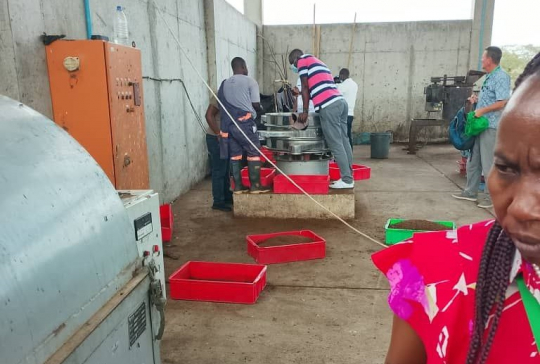
The participants had the opportunity to observe how organic waste is turned into valuable compost.
“We collect fresh organic waste from local markets, sort out non-organic materials, and guide it through weeks of composting process,” explained Jimson Mkenda, the facility’s director.
“The result is nutrient-rich organic fertilizer that supports sustainable farming.”
In addition to composting, the site also breeds Black Soldier Flies, a protein-rich insect increasingly used as animal feed.
Challenges and opportunities at the plant
Despite its success, the facility faces persistent hurdles.
“The main challenge lies in waste sorting,” Jimson Mkenda said. “Non-organic materials often arrive mixed with organic waste, increasing labor costs and reducing efficiency.”
Currently, the plant processes about fifty tons of waste daily, with plans to expand to 150 tons. That is a small but growing share of Dar es Salaam’s estimated 4,600 tons of daily waste. Scaling up composting operations is key to reducing methane emissions and improving urban waste systems.
Participants shared their regional experiences
The visit also inspired cross-country dialogue among fellows on how similar models could work elsewhere in Africa.
“This technique is already being applied in Rwanda for producing animal feed from organic waste,” said Abias Maniragaba, Policy Engagement Specialist from Rwanda.
“The main difference is that in Rwanda, larvae are still harvested manually, while Mabwepande uses a specialized machine.”
Alemayehu Tadele, Senior Expert and IGE Fellow from Ethiopia’s Ministry of Agriculture, said the model offers lessons for his country:
“This facility is an excellent example for Ethiopia to scale up. We import millions of tons of inorganic fertilizer each year, while organic waste remains underused. Composting like this could reduce import costs, create new income opportunities, and improve soil health.
The visit proved valuable to the team by providing insights into ongoing and emerging climate-smart agriculture projects across the region.
By: Saba Yifredew
|
About the IGE in Practice Program: The Inclusive Green Economy (IGE) in Practice program, coordinated by the Environment for Development (EfD) initiative, brings together policymakers and researchers from across Africa to exchange knowledge and tools for green economic transformation. Through regional workshops, applied learning, and peer collaboration, the program helps countries design evidence-based policies that promote both sustainability and equity. |