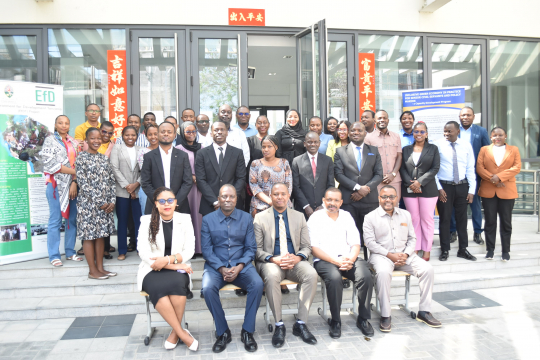
A partnership between researchers and policymakers is paving the way for accelerated adoption of clean energy in Tanzania. This was stated at the national Inclusive Green Economy (IGE) Forum held at the University of Dar es Salaam on July 25, 2025, where government officials and academics pledged to continue working hand in hand to tackle energy and climate challenges through evidence-based reforms.
The forum, which was part of the Sida-funded IGE Program, brought together representatives from key ministries, researchers, development partners, and alumni of the IGE training program. The initiative aims to promote green growth by enhancing the capacity of civil servants to apply economic and environmental policy instruments to national development planning.
Confronting the biomass challenge
Tanzania continues to rely heavily on traditional biomass fuels, with over 85% of households depending on firewood and charcoal for cooking. This trend poses a significant threat to the country’s environmental and public health goals.
“Energy plays a pivotal role in achieving development objectives, particularly in improving citizens’ quality of life while safeguarding the environment,” said Dr. Remidius Ruhinduka, Deputy Commissioner at the Ministry of Finance. “If we want to reduce emissions by 2030, there must be a shared understanding between researchers and policymakers.”
The government recently launched the National Energy Efficiency Strategy (2024–2034), which outlines priorities such as promoting energy-efficient technologies, improving access to clean cooking, and enhancing energy security.
Building capacity for policy impact
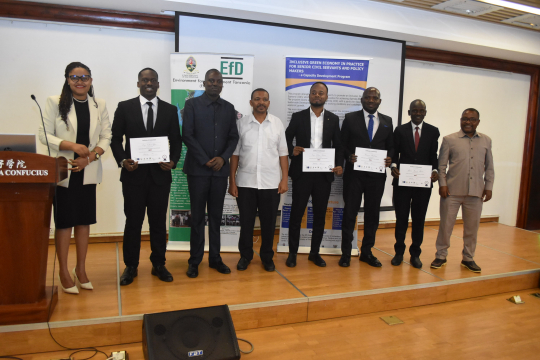
A highlight of the event was the graduation of the 2024 cohort of civil servants under the IGE program. Over the past year, these professionals have worked closely with researchers on the theme Energy efficiency and reduced emissions.
“In the past, there was a significant gap between policymakers and researchers. Researchers had solutions, but decision-makers were unaware of them,” said Dr. Aloyce Hepelwa, Tanzania’s IGE Lead and senior economist. “Through IGE, we are bridging this gap.”
The program has enabled participating ministries—including the Ministry of Energy, Ministry of Finance, Ministry of Industry and Trade, Ministry of Transport, and the Rural Energy Agency—to formulate policy recommendations based on research and practical tools.
“The aim is to promote the adoption of energy-efficient domestic appliances and identify strategies to improve policy enforcement,” Aloyce Hepelwa added.
Overcoming barriers to clean cooking
Despite increased attention at the policy level, the uptake of clean cooking technologies remains limited. Stakeholders at the forum identified cost, low awareness, and entrenched cultural preferences as key barriers.
“Even though electric cookstoves are available, many Tanzanians are unaware of their benefits. There are companies offering incentives for electricity usage, but the public response is still minimal,” noted James Chuyi, an environmental officer from the Vice President’s Office and IGE alumnus.
He underscored the need for household-level interventions, including education campaigns and targeted subsidies, to complement national policies.
Charting a vision beyond 2030
The IGE program, now active in Tanzania, Uganda, Kenya, Rwanda, and Ethiopia, is seen as a vital platform for promoting long-term climate resilience and economic transformation.
“We have trained policymakers to use economic policy instruments to design impactful, evidence-based strategies that support economic growth without harming the environment,” said Aloyce Hepelwa. “This is key to realizing Tanzania’s Vision 2050 and international climate commitments.”
New IGE Leadership to drive the alumni network in Tanzania
The forum concluded with the election of the first IGE Alumni Secretariat in Tanzania, tasked with advancing the program’s vision and expanding its reach.
The elected officials include:
Mr. Gilbert Uforo – Chairperson, Ministry of Industry and Trade, Ms. Mary Mahumi – Vice Chairperson Ministry of Natural Resources and Tourism Tanzania forest Services Agency. The members are Mr. James Chuyi -Vice President’s Office, Ms. Joyce Msangi –Ministry of Energy, and Ms. Haika Victor Mgonja - Ministry of Finance.
Their election marks a new chapter in sustaining the outcomes of the IGE program and expanding policy engagement on inclusive green growth.
By Salvatory Macha