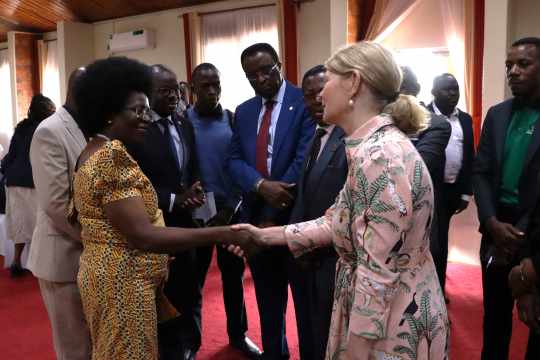
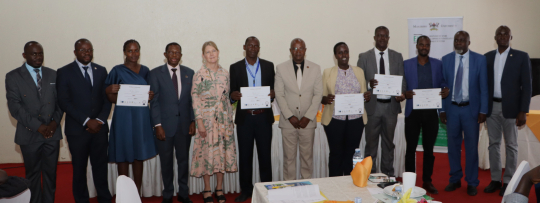
Uganda has been called upon to take leadership in Africa’s electric mobility revolution, following the graduation of the 4th Cohort of Inclusive Green Economy (IGE) Fellows (2024–2025) at Kampala Kolping Hotel. The event also marked the launch of the 2025–2026 IGE cohort, with over 120 participants from government, academia, civil society, and the private sector in attendance.
Funded by the Swedish International Development Cooperation Agency (Sida), the IGE Fellowship is coordinated by the University of Gothenburg in partnership with Makerere University. The program trains senior Ugandan public servants—this year from five key ministries and agencies—in strategies to reduce transport sector emissions and build a green economy.
Swedish ambassador: Uganda is uniquely positioned
Swedish Ambassador to Uganda, H.E. Maria Håkansson, who presided over the ceremony on July 2, 2025, commended Uganda’s progress and challenged the country to lead Africa’s green transition. She emphasized the importance of e-mobility as a climate solution and a driver of sustainable development.
“Uganda, with its abundant solar, hydro, and bioenergy, is uniquely positioned to lead this transition,” she said. “Clean energy must power clean transport.”
Drawing from Sweden’s experience, Håkansson called for investment in EV infrastructure, incentives for electric vehicle use and production, and national awareness campaigns. She stressed the need for collaboration across government, academia, the private sector, and civil society to move from policy to implementation.
To the graduates, she said, “You are pioneers. You have the knowledge and platform to drive innovation and influence policy. Uganda’s future is in your hands.”
Minister Musenero: STI must drive economic transformation
Minister for Science, Technology, and Innovation, Hon. Dr. Monica Musenero, emphasized the need to align science, technology, and innovation (STI) with economic policy to create a sustainable and resilient green economy.
"E-mobility is not just an environmental goal; it’s a development imperative,” she stated. “Without the right economic incentives, even the best technologies won’t scale.”
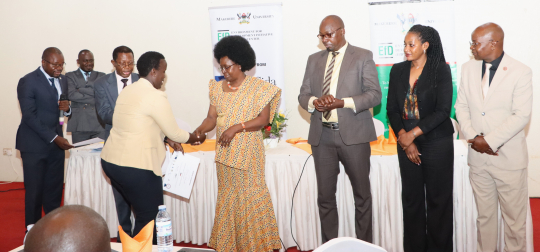
She highlighted Uganda’s leadership through Kira Motors and urged a focus on job creation, manufacturing, and economic sovereignty. Musenero warned against passive adoption of foreign technologies, encouraging African countries to actively shape their role in the Fourth Industrial Revolution.
“We were left behind in past revolutions—not from lack of technology, but lack of vision,” she said. “This time, we have the tools and the responsibility to lead.”
Dr. Musenero also proposed that IGE Fellows be seconded to her ministry for internships and deeper policy engagement.
Prof. Buyinza: Fellows are ambassadors for change
Prof. Mukadasi Buyinza, representing Makerere University’s Vice Chancellor, encouraged the graduates to be ambassadors of Uganda’s green transition.
“This training has equipped you to lead beyond your institutions,” he said. “We must manage the disruptions that come with innovation while advancing development.”

He highlighted the regional and cross-sectoral collaboration within the program as essential for building a green industrial economy. “Green jobs and green skills are the future—and this fellowship is laying the foundation.”
Edward Bbaale: Champions of Uganda’s green shift
Prof. Edward Bbaale, Principal of the College of Business and Management Sciences and Director of the IGE Program, described the fellows as “seeds of transformation.”
“You’ve not only completed a course—you’re now champions of Uganda’s low-carbon future,” he said.
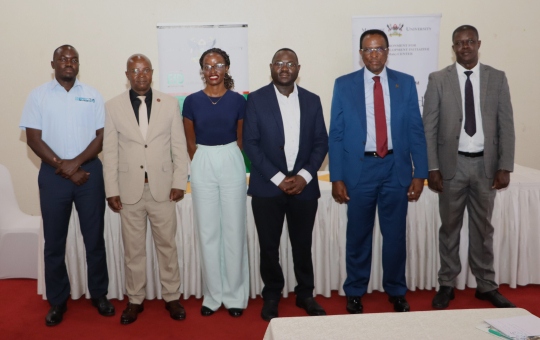
Prof. Bbaale emphasized that e-mobility success requires infrastructure, policy, and economic tools such as subsidies and tax incentives. He lauded Uganda’s leadership, especially the Kira EV initiative, and called on fellows to be bold in shaping policies that reduce emissions and stimulate green growth.
With Uganda poised to become a regional leader in electric mobility, the graduation of the IGE Fellows reflects growing momentum in aligning public policy with climate action and economic development. The call from Sweden, Uganda’s leaders, and Makerere University was unified: move from learning to leadership, and make Uganda a beacon of Africa’s green transformation.
By Jane Anyango & Monica Meeme (Intern)