Government oversight, academic research, and innovation converge to accelerate the adoption of clean energy among youth in the food sector.
EfD Tanzania researchers, together with researchers from the University of Dar es Salaam School of Economics (UDSE), are supporting youth-owned small and medium enterprises (YSMEs) in the food sector to transition from charcoal and firewood to clean cooking energy. This is part of broader efforts to promote a just transition to clean energy in Tanzania. In this initiative, officials from the Ministry of Energy participated as oversight and technical experts, providing policy guidance and supervision to ensure that clean cooking technologies align with national energy priorities, environmental protection objectives, and public health standards.
The engagement brings together academic research, government, innovation, and private sector participation to demonstrate practical pathways for scaling clean cooking technologies within youth-led food and meat processing enterprises.
Benefits environment, health, and efficiency
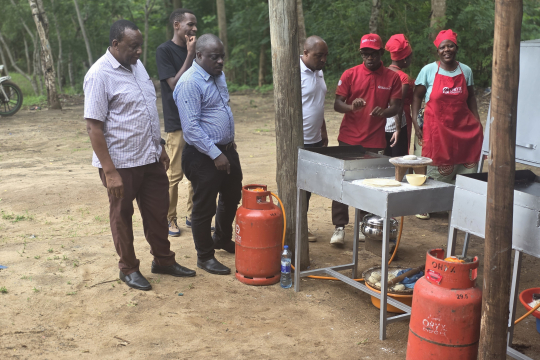
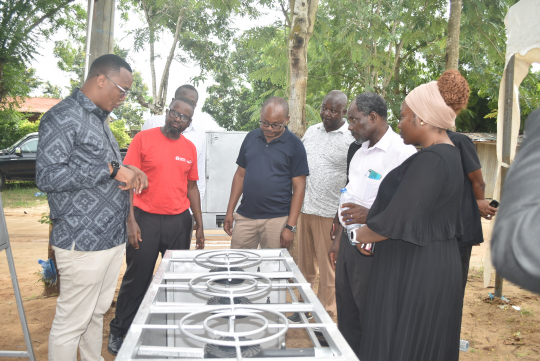
The Director of Clean Energy at the Ministry of Energy, Mr. Nolasco Mlay, spoke during a familiarization visit to a clean cooking energy demonstration held on 31st December 2025 at Matima Investment Group in Kibaha District, Coast Region. He reaffirmed the government’s commitment to expanding the use of clean cooking solutions—particularly gas-based technologies—among food vendors and meat roasters.
Mr. Nolasco Mlay emphasized that supporting youth enterprises to adopt clean cooking energy is critical for reducing deforestation, lowering emissions, and protecting the health of food vendors and surrounding communities.
“The use of clean cooking energy not only protects the environment but also improves health outcomes and increases efficiency across food and meat value chains. Through effective oversight and engagement with stakeholders, the Ministry will continue to supervise and develop the clean cooking sector to ensure safe, affordable, and sustainable adoption,” he stated.
Innovation and technology for clean cooking adoption
Matima Investment Group, a local enterprise specializing in innovation and clean technology, is playing a key role in designing and manufacturing gas cookers and meat roasting equipment suited for food vendors and meat roasters operating at different scales. The equipment is developed using locally available materials and tailored to meet the needs of small and medium enterprises in terms of efficiency, durability, and cost.
During the visit, experts from the Rural Energy Agency (REA) and officials from CRDB Bank inspected the equipment to assess performance, safety standards, and efficiency in real business environments. The engagement underscored the importance of aligning clean energy technologies with financing mechanisms to support uptake by youth entrepreneurs.
Eng. Deusdedit Malulu from REA emphasized that safety, affordability, and user-friendliness are essential for sustained adoption of clean cooking technologies.
“If clean cooking equipment is safe, efficient, and cost-effective, users are more likely to remain with clean energy solutions rather than reverting to charcoal and firewood,” he noted.
University-led support for innovation and a just clean energy transition
Matima Investment Group highlighted that the design and development of the clean cooking equipment was facilitated through technical guidance, research insights, and policy-oriented support from the University of Dar es Salaam School of Economics, particularly under the leadership of Prof. Jehovaness Aikaeli.
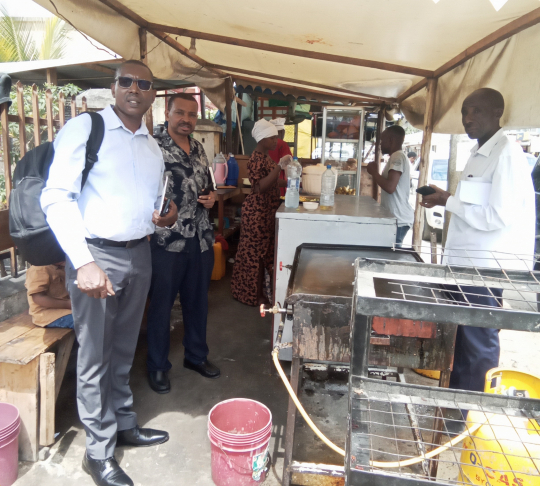
Jehovaness Aikaeli is implementing a project titled Supporting African Youth Entrepreneurs to Accelerate a Just Transition to Clean Energy and Climate-Resilient Businesses, funded by the International Development Research Centre (IDRC), which aims to bridge research, policy, and practice in clean energy. Through this initiative, academic evidence and policy priorities have informed the innovation process, ensuring that technologies respond to both business needs and national climate goals.
Representatives of Matima Investment Group expressed sincere appreciation to the University of Dar es Salaam for its role in supporting innovation, advancing awareness on climate change, and strengthening the national agenda on a just transition to clean energy.
Strengthening research–policy linkages
The visit also provided an opportunity for researchers to observe how clean energy policies translate into practice at the enterprise level. Dr. Kevin Rugaimukamu Mutayebwa, an EfD Research Fellow specializing in energy economics, noted that locally manufactured clean cooking equipment offers valuable lessons for scaling up clean energy solutions across Tanzania.
He emphasized that such engagements help bridge gaps between research, policy formulation, and implementation—particularly in ensuring that the clean energy transition includes youth and informal sector actors.
Mentorship as a driver of sustainable change
Jehovaness Aikaeli underscored that mentorship is central to enabling youth entrepreneurs to successfully transition to clean energy. Beyond technology provision, the project focuses on building capacity, confidence, and long-term commitment among young business owners.
The mentorship framework focuses on Strengthening mentorship approaches for youth MSMEs transitioning to clean cooking energy; Identifying effective strategies to support behavioral and technological change; Engaging suppliers of energy products and financial institutions to support youth enterprises; and Mobilizing mentors and partners to support implementation through access to equipment and financing.
Call for policymakers and researchers
The engagement between the Ministry of Energy (as an oversight and technical authority), the University of Dar es Salaam, Matima Investment Group, REA, Tanzania Meat Board, and financial institutions demonstrates that a just transition to clean cooking energy is achievable when innovation, research, policy oversight, finance, and mentorship are aligned.
Targeted support to youth entrepreneurs in the food sector provides a practical pathway to reduce reliance on dirty fuels, strengthen awareness of climate change, and promote inclusive and sustainable economic development in Tanzania.
By Salvatory Macha