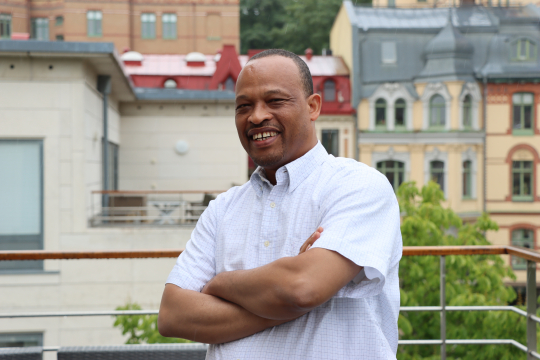
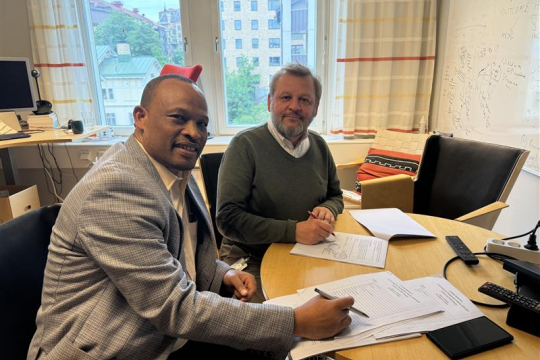
EfD Global Hub’s Director, Gunnar Köhlin, signed an agreement with the President of Addis Ababa University, Samuel Kifle, in November 2024 to transition the EfD center to the University. Hailu Elias has, after 15 years in the EfD network, taken on a new role this year as Director of EfD Ethiopia.
With a strong academic background, profound policy engagement, and a passion for mentoring young researchers, he is now leading the center through a period of transition and growth. We sat down with Hailu to learn more about his vision for the center and the challenges and opportunities ahead.
When did you officially become Director of EfD Ethiopia?
I was appointed to this role by the University of Addis Ababa on March 26 and formally took on the role by the end of March. We’re still in a transition process, but things are moving forward.
How long have you been involved with EfD?
I first joined EfD in 2011 as a student in the Environmental Evaluation course in Gothenburg. Gunnar Köhlin was one of my instructors. Those few months really changed my way of thinking and sparked my interest in becoming part of the network.
What does the team at EfD Ethiopia look like today?
Formally, we are three people at AAU currently on the payroll – me as director and two postdocs. We are currently recruiting more postdocs and administrative staff. But we still retain all the EfD collaborators in Ethiopia, not least our colleagues at the Policy Studies Institute, where the center was located before the transition. There are also many research fellows at AAU, including Professor Alemu Mekonnen, who is heading the Institute of Social and Economic Research that the center belongs to. We’re also working with the team on the Inclusive Green Economy (IGE) program. They’ll continue as associates of our center.
How is the setup of the new center progressing?
It’s going well, though not very fast. The university has provided us with space, and we’ve received funding for renovations – ceiling, painting, lighting, and floors – to create a good work environment for researchers. We’re also working on a detailed work plan and budget for 2026 and have received helpful feedback from colleagues at the Global Hub.
What are your strategic priorities for EfD Ethiopia?
We’re focusing on five key areas:
-
Developing a five-year strategy (2026–2030).
-
Establishing a functioning advisory board.
-
Identifying a research agenda and policy engagement activities.
-
Hosting in-house workshops and seminars.
-
Initiating four new policy-relevant research projects aligned with EfD’s priorities—climate policy and development, sustainable agriculture, sustainable energy transition, and green industrialization and urbanization.
We’re also continuing and following up on existing research, including projects on energy efficiency and sustainable development.
What are the major challenges Ethiopia is facing today?
Despite the ongoing economic reforms and projections of relatively good GDP growth in the coming years, climate change and environmental stress, food insecurity, inflation, rapid population growth, and unemployment are the major concerns. About 75% of our population depends on rain-fed agriculture, and urbanization is accelerating. This brings environmental degradation and increased demand for food, housing, water, waste management, and electricity. Of course, the Ethiopian government is working hard to address these challenges.
Which of these challenges is EfD Ethiopia addressing?
We’re addressing most of those with a special focus on sustainable agriculture and climate policy. Sustainable urban development is also a growing area of interest, particularly in environmental management and infrastructure.
What are you most proud of in your career?
I’m proud that I chose economics. It allows me to work on development and environmental issues that truly matter. I’ve been teaching for over 15 years, advising many master’s and PhD students, and I’m very happy to be working with the young generation. I’ve also held leadership roles at the university and collaborated with international organizations like the UN Food and Agriculture Organization and the International Growth Center.
How do you feel about hosting the EfD Annual Meeting in 2027?
Wow—very eager! I look forward to welcoming everyone to our beautiful country, Ethiopia, to Addis Ababa and our new center. I’m happy to be part of the EfD global family and truly want to contribute. We’ll need support from our colleagues in Gothenburg and beyond, but I’m excited for what’s ahead.
By: Petra Hansson
About EfD Ethiopia
Ethiopia is the birthplace of EfD. EfD, as a network, was launched in 2007 based on the experiences from the Environmental Economics Policy Forum for Ethiopia, which was started at the Ethiopian Development Research Institute in 2003. But since then, EfD has evolved primarily into a network of premier academic institutions with strong links to graduate programs. It was hence a strategic decision to move the Ethiopian EfD center to the Research Center for Sustainable Development under the Institute of Social and Economic Research, Addis Ababa University.