
Saturday evening of the Annual Meeting is traditionally an occasion to present awards and acknowledge other special achievements, as well as reveal where the next EfD Annual Meeting will take place.
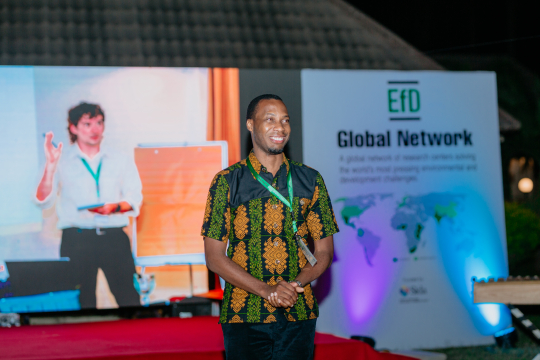
This year’s host, EfD Tanzania Director Martin Chegere, who also celebrated his birthday that day, commenced with a brief presentation of the current work of the center, the research priorities, and their aims for the future, namely: improve their research impact, train the next generation of environmental economists, and deepen their engagement with policymakers.
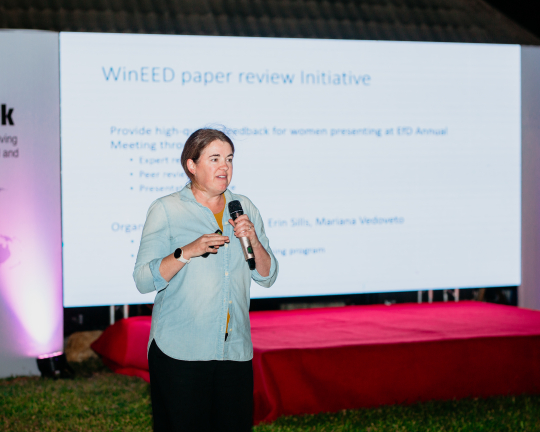
Katrina Mullan from the University of Montana presented a new mentoring initiative by WinEED (Women in Environmental Economics for Development): Women who had submitted papers for EfD’s Annual Meeting 2025 were offered
1. Expert review by senior researchers (men and women)
2. Peer reviews within the group and
3. Presentation practice.
Read more about this initiative!
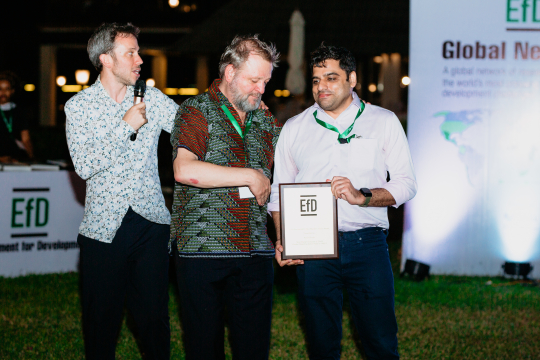
The Gunnar Köhlin Best Master’s Thesis Award went to EfD India and Aman Chotia for his thesis Quantifying the Impact of GRAP (Graded Response Action Plan) on PM2.5. The motivation: This thesis convincingly shows that Delhi’s GRAP policy led to about a 20% drop in daily air pollution, using a rigorous mix of methods to ensure credible results and offering powerful evidence for how forecast-based actions can quickly improve air quality in major cities.
Runners-up were Nassir Millao (EfD Tanzania), Taaka Proscovia Mugeni (EfD Uganda) and Ana Guadalupe Pinto (EfD Central America and Mexico).
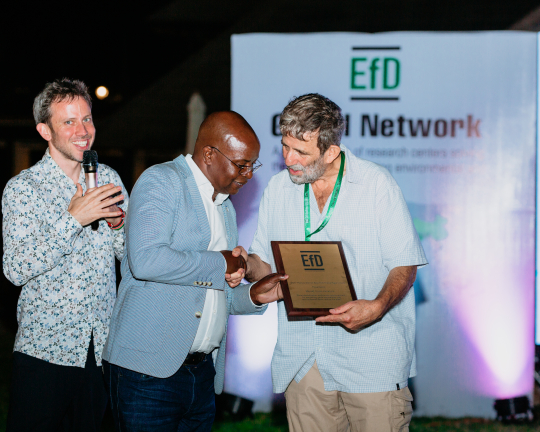
Maxwell Clovice Kamayire, (EfD Uganda), won Thomas Sterner’s Best PhD Thesis Paper Award. The paper, Rural electrification and women empowerment – Do bargaining game approaches with real household items reduce the bias? was co-authored by Fred Matovu, Paul Wabiga, and Aisha Nanyiti. The motivation: Tackling a clearly defined and timely question – how rural electrification shapes women’s bargaining power within households – using solid empirical analysis and careful interpretation. Its strong methodology, clear results, and actionable policy insights make it an excellent example of research that bridges academic rigor with real-world impact.
Runners-up: Kenneth Kigundu Macharia (EfD Kenya) and Sydney Kabango Chishimba (EfD South Africa).
A team of EfD researchers and staff at Nairobi Water and Sewerage Company – David Fuente, Josiah Gitu, Mbutu Mwaura, Richard Mulwa, and Joseph Cook – won Peter Berck’s Best Discussion Paper Award for the paper Improving payment for essential services: A field experiment in Nairobi, Kenya.
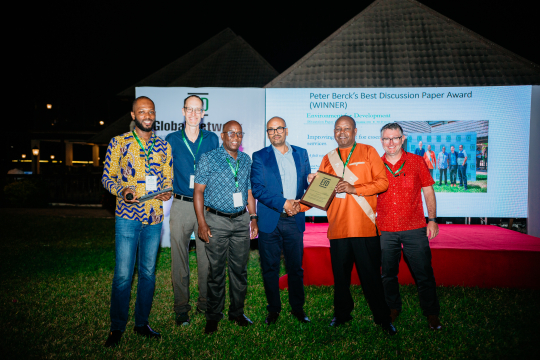
The other finalists were: Zihan Nie, Yu Jiang, César Salazar, Marcela Jaime, and Thong Ho for their paper Consumers’ preferences for testing algal bloom in seafood markets: A comparison study of mussel consumption in China, Vietnam, and Chile, and Bui Bich Xuan, Quach Thi Khanh Ngoc, Claire W. Armstrong, Kofi Vondolia, and Pham Khanh Nam for Understanding non-compliance with rights-based fisheries management in Vietnam.
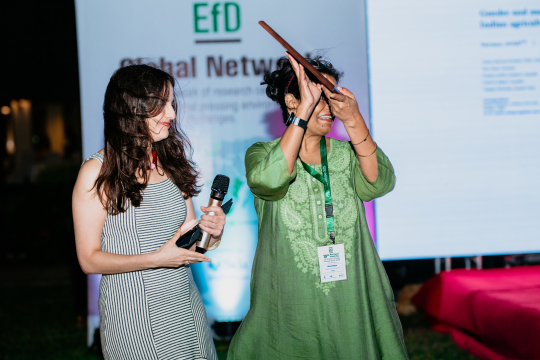
Farzana Afridi, Monisanker Bishnu, and Kanika Mahajan, with their paper Gender and mechanization: Evidence from Indian agriculture, won the EfD Gender Research Award, which was presented for the second time at the EfD Annual Meeting in Dar es Salaam.
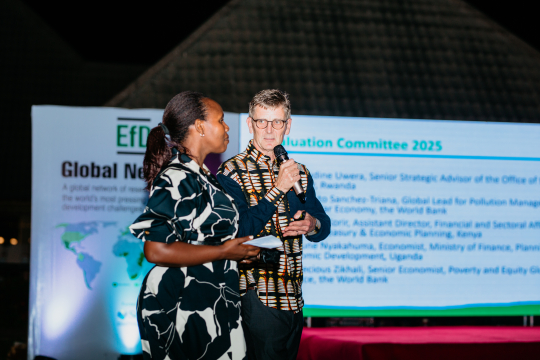
The EfD Policy Impact Award was presented by Precious Zikhali, Senior Economist at the World Bank and a member of the evaluation committee, and EfD Policy Engagement Director Daniel Slunge to two runners-up who received a certificate of excellence and one winner.
Recipients of the certificates of excellence were:
Le Thanh Loan, Tran Duc Luan, and Phung Ngoc Trieu for their work Bridging research and policy for climate-smart rice farming: Laser land leveling in Vietnam and Martin Visser and Jane Turpie for Natural capital accounting for enhanced environmental-economic decision-making in South Africa.
Winners of the EfD Policy Impact Award were Bing Zhang, Liu Mengdi, and Jintao Xu for Corporate environmental information disclosure and public participation in China.
Excerpt from the motivation: They receive the award for their pioneering research on corporate environmental information disclosure and its impact on governance in China. The findings, published in journals, together with close collaboration with the Ministry of Ecology and Environment and other organizations, have directly informed national regulations now guiding disclosure practices for over 80,000 enterprises. Their work has contributed to reductions in pollution violations.
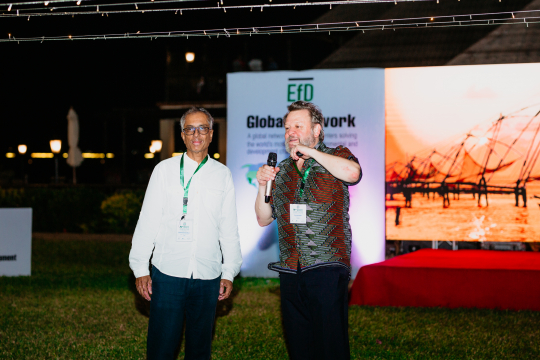
Finally, the location for the two upcoming EfD Annual Meetings was revealed: The EfD Annual Meeting 2026 will be hosted by EfD India in Kerala, and in 2027, the host will be EfD Ethiopia.
Congratulations to all the winners and a warm thank you to all the evaluation committees!
Text: Petra Hansson
Photos: Aclovius Kamanyonga.