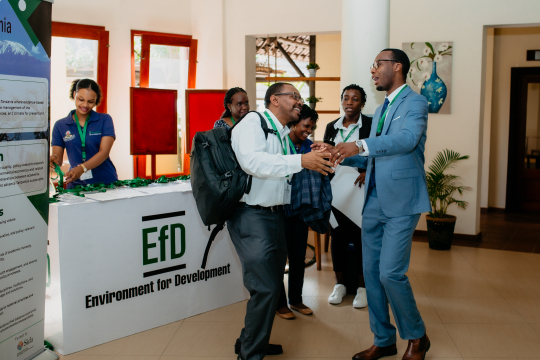
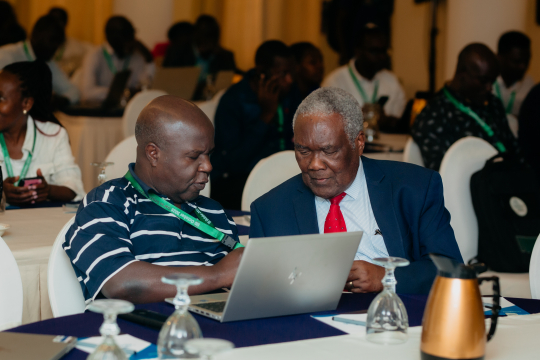
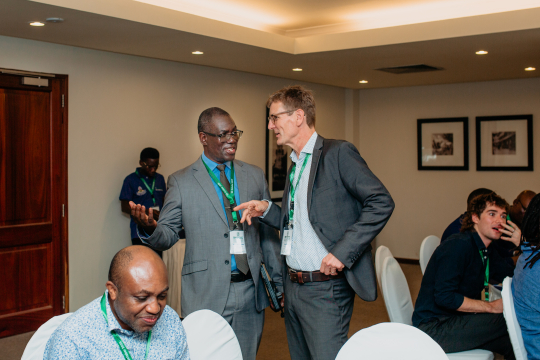

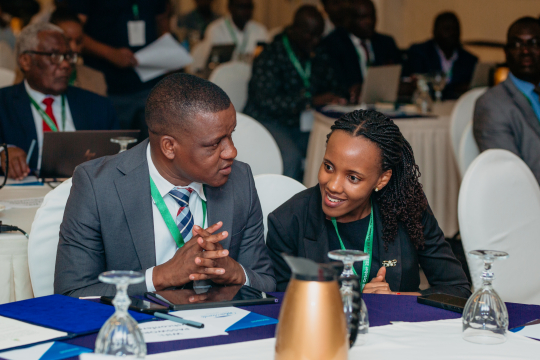
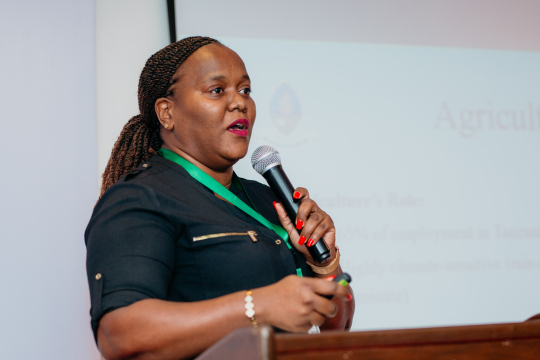
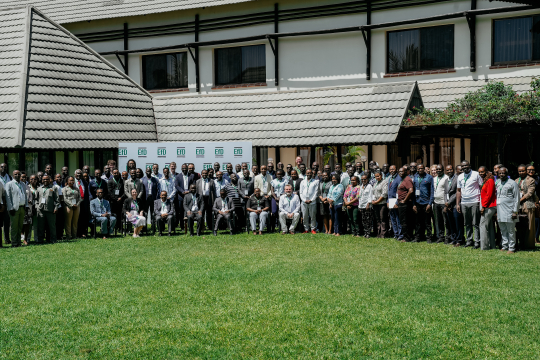
The EfD Policy Day 2025 brought together policymakers, researchers, and practitioners to explore pathways for building resilient and sustainable agriculture in Eastern Africa. The event, which took place on October 15th, generated fruitful discussions and knowledge sharing.
Finding solutions for climate-resilient and sustainable agriculture is among the most urgent challenges for Africa. Agriculture is both highly vulnerable to climate change and a major contributor to it, accounting for roughly a fifth to a quarter of global greenhouse gas emissions. Climate-Smart Agriculture (CSA) has emerged as an approach to address this dual challenge by simultaneously increasing agricultural productivity, enhancing resilience, and reducing emissions.
“This high-level workshop brought together over 120 researchers and representatives from ministries in Ethiopia, Kenya, Rwanda, Tanzania, and Uganda, as well as practitioners. This paved the way for a great exchange of knowledge and constructive discussions,” says Dr. Martin Chegere, Director of EfD Tanzania, at the University of Dar es Salaam, School of Economics (UDSE).
Government aims to boost productivity and empower women and youth
The Policy Day commenced with two keynote presentations. Mr. Pastory Ndalahwa, representing Mr. Gerald Mweli, Permanent Secretary of the Ministry of Agriculture, discussed how Tanzania’s 2050 vision places agriculture at the heart of national growth through resilience, innovation, and partnerships.
“This vision plan aims to modernize farming, boost productivity, and empower women and youth. Key goals include a fivefold rise in agricultural GDP, stronger climate resilience, and expanded value addition. Collaboration across sectors will drive Tanzania toward food security, prosperity, and global competitiveness,” he said.
Indigenous crops can boost yields, resilience, and nutrition
The second keynote speaker, Dr. Innocencia John, EfD Tanzania, talked about building resilient and sustainable agriculture by integrating indigenous crops into climate-smart agriculture. She highlighted research that shows that traditional crops like millet, cowpea, and pigeon pea can boost yields, nutrition, and resilience while cutting emissions. Innocencia John called for stronger policies, research, and community action to make these crops central to a sustainable farming future.
The keynotes were followed by interactive group discussions on three different themes:
* Climate-smart agriculture & environmental stewardship;
* Green finance, carbon markets and fiscal Incentives;
* Inclusive agri-economies & livelihoods.
A panel discussion synthesized the key issues, the opportunities, and actionable recommendations from all the sessions.
Professor Edwin Muchapondwa, EfD South Africa, summarized the group discussions. He noted that Tanzania’s Vision 2050 and the evidence on how to achieve resilient and sustainable agriculture align very well. He also listed five key takeaways from the discussions:
Agriculture as an ecosystem
One of the central messages was the importance of viewing agriculture as an ecosystem rather than a collection of separate sectors. Research shows that integrated approaches—linking crops, livestock, and forestry—lead to higher productivity and greater resilience to climate shocks. This systems thinking is essential for transforming agriculture into a driver of both economic development and environmental stewardship.
Start with what works locally
Edwin Muchapondwa urged policymakers to build on what already works locally. Indigenous crops like cassava, sorghum, and pigeon pea are naturally resilient. When local knowledge is combined with scientific innovations—such as drought-tolerant varieties or precision irrigation—the results are powerful: increased yields, improved climate resilience, and reduced emissions. CSA, he stressed, should be co-created with communities, not imported as one-size-fits-all solutions.
Institutions more important than technology
However, scaling these innovations requires more than just technology. Institutional capacity, coordination, and incentives play a critical role. Farmers are more likely to adopt new practices when they have access to reliable information, fair markets, and financial support. Muchapondwa called for stronger research partnerships to help design effective extension services, climate information systems, and inclusive finance models that reach smallholders –especially women and youth.
Green finance and carbon markets possible solutions
The discussions had also addressed the growing interest in green finance and carbon markets. While these mechanisms offer promising opportunities to fund sustainable agriculture and land restoration, they must be designed with integrity and transparency. Projects should ensure equitable benefit-sharing and be rooted in strong local ownership and monitoring systems to avoid excluding vulnerable communities.
No resilience without inclusion
Finally, inclusion was underscored as a cornerstone of resilience. Research consistently shows that empowering women and youth in agriculture leads to better outcomes in productivity, innovation, and food security. Policies that support land rights for women, access to finance for youth, and skills development can deliver measurable benefits within just a few seasons.
“The challenge now is to ensure that scaling up is informed by science – moving from promising pilot projects to nationwide transformation. EfD and its partners stand ready to support this journey, working alongside government, communities, and development actors to build a resilient, low-carbon, and inclusive agricultural future,” said Edwin Muchapondwa.
Knowledge sharing and innovation are key
Among the closing remarks, Naomi Wangeci Kihara, Ministry of Agriculture and Livestock Development, underlined the importance of cross-country collaboration in the East African community and also taking advantage of global knowledge.
“Developed countries have done a lot on carbon markets, among others, and carbon pricing, so there is no need to start from scratch. Using existing knowledge, we can move fast,” she said.
Anna Tjärvar, Counsellor at the Embassy of Sweden, talked from her role as an agronomist who works with development projects, among others with Sida and the Swedish Board of Agriculture. She underlined the important role agriculture has in addressing the triple planetary challenge.
“To achieve sustainable growth, livelihoods, food security and renewable energy we need innovation. Why not a Nobel Prize in agriculture?” she said.
John M Mtui, Acting Dean of Uni of Dar es Salaam School of Economics finally concluded that “we are not short of ideas. We now need to turn them into action”.
Comments from the participants

|
Netsanet Tesfaye Tujo, Ministry of Irrigation and Lowland Areas, Ethiopia. “I’m very happy to get this chance to participate in this event. With so many people from different countries with different experiences and knowledge, we really learned a lot from each other. I got a lot of new knowledge on Climate-Smart Agriculture in an East African context.
|

|
Lindokuhle Njozela, University of Cape Town, “It was really interesting with this cross-country sharing of experiences. There are some challenges that we have in common and others that are country-specific. Even though I’m active in one of EfD’s collaborative research programs (NatCap), this kind of cross-country learning is unique for this kind of forum.”
|

|
Nathan Mununuzi, Ministry of Water and Environment, Uganda. “The interactive group sessions were very productive. By working with researchers, it’s really possible to come up with inclusive policies. It also became very clear that to develop the agricultural sector, we must consider many factors, such as market demand, post-harvest handling, and value addition. If not, an increase in production may not increase the income.
|

|
Saba Yifredew, Research Fellow and Policy Engagement Specialist at EfD Ethiopia “I learned a lot! My group discussed green finance, carbon markets, and fiscal incentives. Everyone could chip in with their own examples. Some key issues with carbon markets are transparency, data monitoring, and harmonization. We have also been relying too much on REDD+, since it’s easy to implement, but we should really take into account emissions from livestock, which are the biggest emitters in agriculture.
|

|
Hamis Simba, Economic Social Research Foundation (ESRF), Tanzania. “There were many good ideas presented and a huge knowledge exchange. Currently, we have many strategies, but the policies to implement them are not in place. We talked about tools, equipment, and finance solutions to reduce emissions, and how to link policies with the community to fill that gap.” |
By: Petra Hansson.