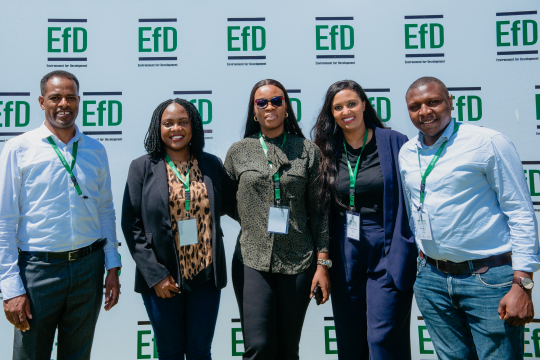
The Environment for Development (EfD) initiative is welcoming six new postdoctoral researchers who will reinforce its collaborative research programs and strengthen policy engagement.
EfD’s collaborative programs bring together researchers from across the globe, including the Global North, to address pressing environmental and development challenges in the Global South. The collaborative research programs are one of EfD’s main pillars for policy-relevant research, each focusing on a specific thematic area.
While this geographical focus presents unique difficulties, the new structure—with dedicated postdocs based locally—will enhance EfD’s presence on the ground and improve connections with policymakers.
“These postdocs will not have teaching responsibilities. Instead, they will dedicate their time to research and policy engagement activities,” explains Alejandro López-Feldman, EfD’s Director of Research.
Hired for two-year terms, the postdocs will contribute by supporting research proposals, serving as points of contact within their programs, and facilitating engagement with policymakers in their respective countries.
Meet the postdocs
- Selamawit G. Kebede, based at EfD Ethiopia (Addis Ababa University), works with the Sustainable Energy Transitions Initiative (SETI).
“I focus on projects related to burning plastic waste for fuel, e-cooking, and gender dynamics, as well as preparing grant proposals,” says Selamawit Kebede. “Having participated in EfD’s Early Career program, I gained valuable training in research methods and policy engagement. I also hope my role as Secretary General of the African Association of Environmental and Resource Economists (AFAERE) will strengthen my contributions here.” - Kevin Maina, stationed at EfD Kenya, joins the Sustainable Consumption and Production (SCOPE) program.
“I was particularly drawn to this opportunity to use research to influence policies on responsible production and consumption in low- and middle-income countries,” Kevin Maina explains. “This isn’t just a personal career step for me—it’s a chance to contribute to long-term solutions for development challenges in the Global South.” - Chizoba Oranu, at EfD Nigeria, works with the Climate Policies for Development (CPfD) program.
“This position will further strengthen my research and policy engagement expertise and accelerate my transition to becoming an independent researcher,” Chizoba Oranu notes. “I aim to produce policy-relevant research outputs, secure research grants, and facilitate policy dialogues.” - Fawzia Muhammed Zuka, based at EfD Ghana, works with the Blue Resources for Development (BlueRforD) program.
“I was drawn to this postdoctoral position because it uniquely combines policy-relevant environmental economics with the pressing challenges of fisheries, aquaculture, and coastal community resilience in the Global South.” - Erica Mtenga (EfD Tanzania) and Gemeda Olani (EfD Uganda) are both part of the Natural Capital (NatCap) program, which is divided into two subsections. Erica Mtenga is focusing on the Forest & Agriculture subsection, while Gemeda Olani is concentrating on Water & Ecosystems.
“I will focus on water systems, biodiversity, and ecosystem services in Uganda and Sub-Saharan Africa,” says Gemeda Olani. “My goal is to produce high-quality research that informs policy and practice, develop approaches to connect ecological and socioeconomic outcomes, and build collaborative partnerships within EfD. I will also work to secure external funding to expand EfD’s research portfolio.”
“I anticipate that my most important contributions will involve conducting and disseminating empirical evidence related to forestry and sustainable agriculture in sub-Saharan Africa and providing actionable policy recommendations to enhance lives in the region,” says Erica Mtenga.
The fact that they are all early-career researchers will add fresh perspectives on the research. Experience is often regarded as the key to driving scientific discoveries, and this is, of course, often true. However, there is also evidence, as this article argues, that diversity in research teams, for instance, by combining early-career researchers with more experienced ones, can generate more innovative and disruptive research.
Together, these six postdocs will strengthen EfD’s ability to generate impactful, policy-relevant, and innovative research while building stronger bridges between science and decision-making in the Global South.
By: Petra Hansson.