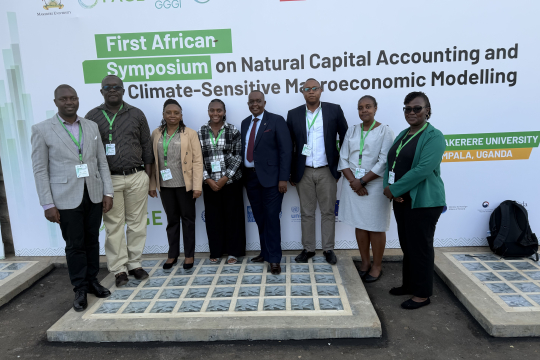
As African economies face growing climate risks, policymakers, academics, and development partners are increasingly seeking tools that integrate environmental sustainability with macroeconomic decision-making. This was addressed at the First African Symposium on Natural Capital Accounting and Climate-Sensitive Macroeconomic Modelling, held on 12–13 February 2026 at Makerere University in Kampala.
The symposium highlighted persistent challenges, particularly data gaps and limited technical capacity, that continue to constrain the integration of climate variables into macroeconomic models and, ultimately, policymaking. Researchers from the EfD Kenya contributed to discussions shaping how governments can better account for climate and natural capital in national planning.
Richard Mulwa highlighted a critical policy tension often overlooked during the keynote panel session:
“While models may indicate optimal resource extraction levels, political pressures, especially during election cycles, frequently drive decisions that exceed sustainable limits,” he noted.
“Thus, meaningful progress in natural resource conservation ultimately depends on the priorities and commitment of the government in power.”
Practical models in use
Participants examined modelling tools already supporting real-world policy decisions. Among them was the Model for Natural Capital Policy Assessment (MONCAP), an Excel-based framework developed by EfD Uganda for Uganda’s Ministry of Water and Environment. MONCAP enables policymakers to incorporate environmental assets, natural capital, and climate risks into national planning.
Similarly, the Integrated Green Economy Modelling Framework (IGEM) demonstrates how macroeconomic planning can integrate poverty dynamics, land use, and environmental change. Applications in countries such as Mexico and Brazil illustrate the potential of such tools to guide more sustainable economic pathways.
Kenya’s efforts to integrate natural capital into planning
The discussions resonated strongly with Kenya’s ongoing efforts to embed natural capital into national statistics through the National Plan for Advancing Environmental Economic Accounting (NPAEEA) 2025–2028, a roadmap to integrate environmental data into national statistics and decision-making across sectors such as land, water, forests, ecosystems, energy, and minerals.
“Such critical frameworks enable more informed and sustainable development decisions”, said Kenneth Kigundu.
Grounding macro models with household realities
Beyond macroeconomic modelling, EfD Kenya researchers emphasized the importance of incorporating behavioral evidence from households and farms.
A poster presented by Boscow Okumu highlighted findings from a study on smallholder farmers’ willingness to pay for agroecological and agroforestry services in Kenya’s Arid and Semi-Arid Lands (ASALs).
The research revealed, by using a choice experiment approach, that farmers see a tangible economic value in sustainable land management practices. The results show that farmers are positive towards climate adaptation investments.
Reflecting on the findings, Okumu stressed the broader policy implications:
“Our findings show that farmers are not passive recipients of climate policies. They actively value and are willing to invest in sustainable practices when the benefits are clear. This kind of micro-level evidence is essential for designing macroeconomic and climate policies that are both realistic and effective.”
By: Jane Maina