
Stakeholders from across Ghana's environment and climate sectors convened for an EfD Ghana workshop to examine the engagement processes preceding the Emission Levy Law, lessons from its implementation, and implications of its repeal. Passed in 2023 and repealed in 2025, the law provides a valuable case for reflection on sustainable emissions financing.
The workshop, themed Financing Carbon Emissions in Ghana, was jointly organized by EfD Ghana and the Environmental Protection Authority (EPA) under the Climate Policy for Development (CPfD) program. It offered the project team first-hand insights into the law, the quality of stakeholder engagement, and key challenges in implementing emissions-financing frameworks.
“It is encouraging to see all the key stakeholders in environmental and climate finance in one forum. I am confident that the exchanges and insights shared here will help shape recommendations to inform the design and implementation of future emissions-financing frameworks in Ghana,” said Anthony Amoah, the project lead.
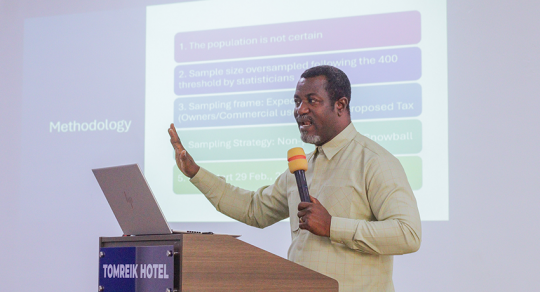
First hand insights on emissions policy and stakeholder engagement

The session featured three presentations. Anthony Amoah opened the discussions with a presentation on carbon emissions from the perspective of prospective payers. He highlighted perceptions, concerns, willingness to pay, and the importance of inclusive engagement in the design of emissions-related fiscal policies. He noted concerns about limited consultation, uncertainty over how levy proceeds would be used, and questions of fairness given Ghana's low contribution to global emissions. The levy's subsequent repeal underscored the importance of research, broad consultation, and transparency in emissions-related taxation.

Daryl Bosu, Deputy Country Director of A Rocha Ghana -- a conservation-oriented organization and part of an international network working to demonstrate God’s love for creation -- shared civil society perspectives on environmental governance and stakeholder engagement. He noted that while Ghana contributes minimally to global emissions, it faces severe climate impacts. He argued that the country may not yet be at a point where direct taxes should be imposed on citizens, calling instead for carefully structured and targeted tax initiatives rather than blanket rates. He also stressed the need for government to create enabling and equitable conditions for businesses and individuals to engage in climate action, rather than relying solely on taxation.
Daniel Benefoh, Acting Director of the Climate Change Unit at the Environmental Protection Authority (EPA), provided regulatory and policy insights into the Emission Financing and Ghana’s broader climate policy framework. He explained that the EPA is working to establish a robust carbon emissions accounting system, addressing existing gaps such as the lack of industry-level emissions data and a country-specific accounting formula, which are critical for effective climate management.

Focus groups deepen insights
Three focus group discussion allowed participants to explore key questions in depth and freely share their perspectives. Each group lead presented a summary of insights, fostering cross-sectoral dialogue. Key contributors for continued engagement were identified, and a Mentimeter tool was used to validate responses.
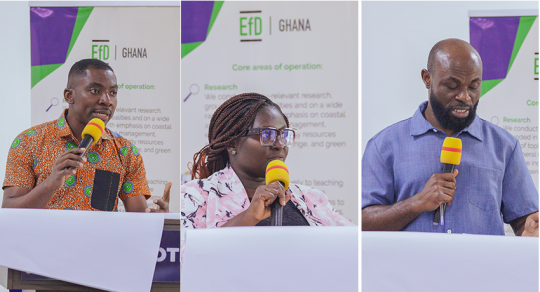
The workshop, held on 12 December 2025 in Accra, will inform evidence-based recommendations for more inclusive, effective, and sustainable climate financing and environmental policymaking in Ghana. Key recommendations included the need for research and broader stakeholder consultation before introducing tax mechanisms to fund Ghana’s climate actions, alongside improved information-sharing and transparency, particularly clarity on how proceeds from any future emissions-related levies would be used.
By Vicentia Quartey