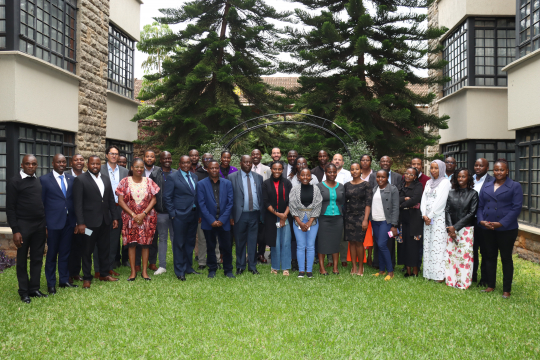
Kenya is leading a conversation on two of the continent’s fastest-growing environmental threats: textile waste and electronic waste (e-waste). In a two-day policy workshop, experts, policymakers, researchers, and community actors from Kenya, Ghana, Nigeria, and Europe gathered to rethink how the continent handles its mounting waste crisis-and how that waste can become an opportunity.
The workshop was arranged by the Sustainable Consumption and Production (SCOPE) collaborative program and took place on 30th June and 1st July 2025
Fast fashion leads to slow decay
The first day of the workshop focused on textile waste. Professor Richard Mulwa delivered a sobering keynote address, warning that the fashion industry is now the second most polluting sector globally, rivaling even oil. He painted a picture of an industry driven by micro-trends, online shopping, and influencer culture, where garments are worn fewer times and discarded quickly. According to Mulwa, about 75% of global textiles are either landfilled or incinerated.
Case studies from Kenya, Ghana, and Nigeria revealed a common reality: the second-hand clothing trade, while economically vital, is producing vast amounts of unusable clothing that ends up in landfills, rivers, and informal dumping sites, like Nairobi’s Dandora. Kenya, for instance, imported nearly 200,000 tonnes of second-hand clothes in 2023, up to half of which could not be sold. Ghana’s Kantamanto Market and Nigeria’s urban centers face similar issues, with waste piling up on beaches, in landfills, or being openly burned.
Turning waste into opportunity
Yet amid the crisis, hope emerged. Speakers highlighted women-led upcycling ventures, informal tailors and repair artisans, and social enterprises that are redefining textile waste as a resource.
“Textile waste isn’t just pollution – it’s potential,” said Dr. Ifeoma Quinette Anugwa from Nigeria.
“We must turn the dress that refuses to die into a bag, into jewelry, into opportunity.”
Toxic e-waste is managed unsafely by informal workers
On the second day, the spotlight shifted to e-waste – the often invisible, but deeply toxic stream of waste growing rapidly across the continent. As access to cheap electronics increases, so does the pile of discarded devices. In Kenya, the bulk of e-waste is processed by informal workers using unsafe methods like open-air burning, without protective gear or environmental safeguards.
Weak policies
Representatives from the E-Waste Initiative Kenya (EWIK) stressed that e-waste is both a health hazard and an economic loss. While it contains dangerous toxins like mercury and flame retardants, it also holds valuable recoverable materials like gold and copper. Despite this potential, only 17% of global e-waste is formally recycled. Kenya’s situation is no different. While the country has a handful of formal recyclers, most lack access to significant waste volumes and struggle to compete with the informal sector, which handles about 70% of all e-waste.
From Ghana’s limited success implementing its 2016 E-Waste Act to Nigeria’s fragmented enforcement of Extended Producer Responsibility (EPR) regulations, the message was clear: policies exist, but are often underfunded, unenforced, or poorly aligned. As policymakers emphasized, e-waste presents both a serious environmental threat and a significant economic opportunity – one that requires a shift from simply discarding waste to harnessing its value through circular solutions.
Urgent need for evidence-based solutions
Despite differences in scale and approach, both workshops uncovered shared themes. Weak regulation, lack of reliable data, limited funding, and poor integration of the informal sector are crippling effective waste management across Africa. Participants emphasized the urgent need for evidence-based policymaking, including national waste inventories, life-cycle assessments, and better tracking of both imported and locally generated waste.
They also stressed the need for harmonized national and county-level policies, stronger enforcement of import regulations, incentives for circular economy models, and greater public education. Crucially, participants highlighted the need to recognize and support informal workers formally: tailors, traders, dismantlers, and waste pickers, who are already doing the heavy lifting of reuse, repair, and recycling.
Gender equity was another key concern, with many participants pointing to the underrepresentation of women in policy and leadership roles within both the textile and e-waste sectors. Calls were made for inclusive training programs, financing mechanisms for women and youth, and gender-sensitive infrastructure planning.
A circular future is within reach
Despite the sobering statistics, the workshops ended on a hopeful note. Examples of successful interventions, like Africa Collect Textiles, Nigeria’s E-Terra, or Ghana’s early regulatory reforms, provided blueprints for scalable change. Participants agreed that with political will, coordinated action, and investment in infrastructure and innovation, the waste problem could be transformed into a source of green jobs, environmental protection, and industrial growth.
As one participant summarized, “What we need now is not just waste management, but a waste revolution-one that is circular, just, and homegrown.”
The SCOPE Policy Workshops mark an important step toward that revolution, forging new partnerships and policy pathways that could turn Africa’s waste crisis into one of its greatest opportunities.
By: Hannah Ngugi