Agriculture is the backbone of economies in East Africa, employing about 60 percent of the workforce and contributing on an average to 30 percent of gross domestic product. Yet agricultural growth rates in the region remain below potential, hindered by limited technology adoption, low productivity, and growing climate risks. These challenges not only threaten livelihoods but also undermine food security across the region.
To address these barriers, the Inclusive Green Economy (IGE) in Practice program has dedicated its 2025/26 cycle to climate-smart agriculture (CSA).
Rightly practiced, CSA offers the triple wins of sustainable increase in productivity, strengthened resilience, and reduced greenhouse gas emissions. Through the IGE program, policyactors (IGE fellows) from Ethiopia, Kenya, Rwanda, Tanzania, and Uganda build their capacity to design inclusive, evidence-based agricultural policies in collaboration with researchers from the EfD network. The IGE program also serves as a hub for sharing cross-country experiences in the region.
Unpacking agricultural challenges through the problem tree
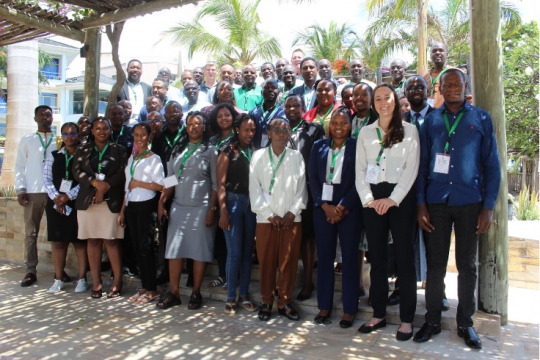
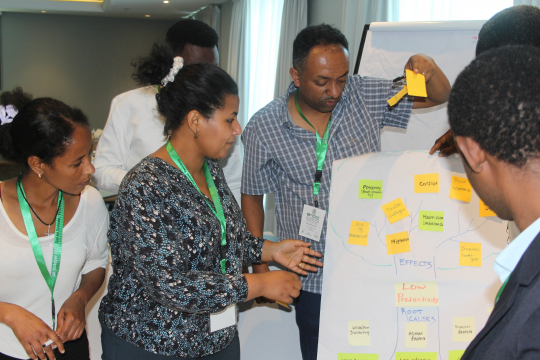
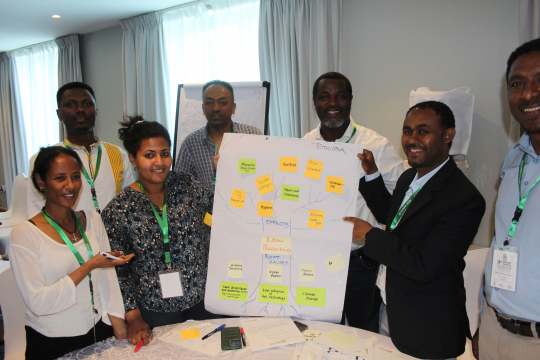
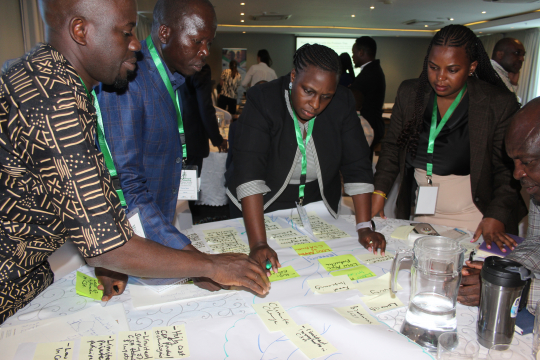
At IGE’s regional workshop in Dar es Salaam, Tanzania, the fellows engaged in an interactive session using the problem tree method to explore the root causes of agricultural challenges in their home countries. This session was part of a series of IGE capacity-building activities that included virtual trainings on economic policy instruments and national systems for CSA, economic policy instruments, and national systems for IGE. They aim to equip the civil servants with practical analytical tools to inform and influence policy development in their organisation, typically a government ministry or agency.
The problem tree exercise helped the fellows visualize cause and effect relationships and uncover deeper structural linkages. It encouraged them to move beyond initial perceptions, ask deeper questions, and develop a more nuanced understanding of complex policy challenges.
The country teams of civil servants and researchers focused on the problems of low productivity and low adoption of climate-smart agriculture technologies. The diagnostic tool proved instrumental in equipping the civil servants with a structured analytical framework that they can carry into the design of their day-to-day work.
Local context matters: Rwanda’s experience
For Aradukunda Peace, an IGE fellow from Rwanda’s Environment Management Authority, the exercise was a turning point in understanding the value of context-specific approaches. Rwanda’s hilly terrain, she noted, makes agriculture prone to soil erosion and demands tailored practices.
“The problem tree exercise revealed root causes such as limited evidence-based decision-making and using approaches from other countries that may not fit Rwanda’s conditions,” she said.
She shared that the sessions encouraged a deeper understanding of how countries in the region approach CSA in different ways.
“We do not all understand climate-smart agriculture in the same way. For example, practices like sprinkler irrigation are perceived differently depending on context. We have a lot to learn.”
Madeleine Usabyimbabazi, Environment and Climate Change Specialist at Rwanda’s Agriculture and Animal Resources Development Board, also emphasized the importance of adapting CSA to local conditions.
“We began with a long list of problems and ended up narrowing them down depending on how they influence CSA practices upstream. Whenever a CSA practice is proposed without proper testing on the ground, it often turns out to be inconvenient in the local context.”
She cited examples of practices that sound promising but are difficult to apply in Rwanda’s smallholder systems.
High costs and labor requirements also limit the uptake of CSA innovations. The use of organic fertilizers requires high capital investment and manual labor,” Madeleine said.
“To achieve the same nitrogen and phosphorus levels as synthetic fertilizer, you need large quantities of manure, which is not easy for smallholders.”
For Madeleine, one of the most valuable outcomes of the exercise was the commitment to collaboration:
“Civil servants from different organizations will create a coalition to influence change. This platform helps us understand the issues on the same level and put forward collaborative solutions.”
Policy and fiscal alignment: Uganda’s perspective
Gertrude A. Basiima, Assistant Commissioner at Uganda’s Ministry of Finance, Planning and Economic Development, echoed this concern from a fiscal standpoint:
“If it is not in the national budget, it is not a priority,” she said. “Climate Smart Agriculture must secure its place in the budget through collaboration and alignment among ministries, departments, and agencies.”
Thomas Epeet, representing Uganda’s Ministry of Agriculture, emphasizes that one of the greatest hurdles to advancing CSA across East Africa is the absence of dedicated policy instruments. He observes: “Countries depend on related documents and guidelines to formulate CSA.”
Uganda’s current policy focus includes promoting irrigation, mechanization, and precision agriculture to enhance resilience. But Thomas Epeet emphasized that interventions must be grounded in empirical diagnosis rather than assumptions: Reflecting on the problem tree exercise within the IGE training, he explains: “A single problem can have many root causes. We need to rank and prioritize. Interventions should not be random—they must be evidence-based and relevant.”
Thomas Epeet appreciates the cross-country learning facilitated by IGE:
“It was eye-opening to see how challenges differ. Some countries have large chunks of land but not arable land. Others don’t have data.” He noted that such cross-country exchanges deepen understanding and inspire more context-specific, practical solutions for advancing climate-smart agriculture.
Strengthening coordination in Kenya’s counties
From Kenya, Leon Nyanjom, Senior Devolution Officer at the State Department for Devolution, emphasized the role of intergovernmental coordination in advancing CSA adoption.
“The problem tree exercises helped us agree on our Transformation Initiative (TI) challenge. We identified low adoption of CSA practices as our TI challenge through the problem tree exercise,” he said,
“In Kenya’s 57 counties, agriculture is a decentralized function, and one of our mandates is to support counties through capacity building and coordination.”
Looking ahead
Over the coming months, the fellows will engage with colleagues in their respective institutions, EfD researchers, and the IGE support team to refine their country-specific TIs. The broader goal is to strengthen their capacities to inform and enhance national strategies and strengthen agricultural resilience in the face of climate change.