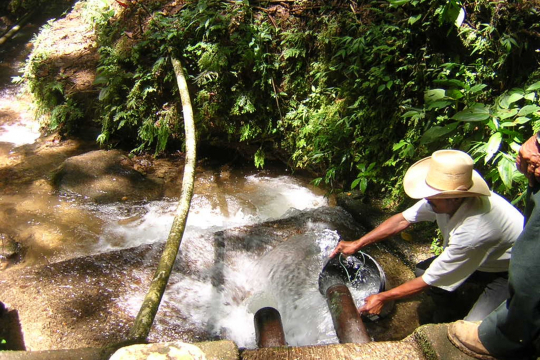
Community-based drinking water federations play a critical role in coping with climatic and non-climatic threats to secure safe water in rural areas of Latin America. EfD CAM is launching an ambitious three-year research project to strengthen these networks and provide evidence-based solutions for effective water governance in the Global South.
The EfD Central America and Mexico (EfD CAM) project was selected amongst more than 500 proposals submitted to the Tinker Foundation, a leading philanthropic organization supporting impactful initiatives in Latin America.
The project will be led by Róger Madrigal, EfD CAM Director, in collaboration with Seattle University (USA) and the Pontificia Universidad Javeriana (Colombia). The study will explore the institutional, economic, and spatial factors that motivate the emergence of community-based drinking water federations in Colombia and Costa Rica and influence their performance. It will also explore their viability as a replicable governance model for Latin America.
The three-year research project officially started in July 2025 and will run until June 2028. Currently, the team is in the initial phase of the study, developing information-gathering protocols, mapping key stakeholders, and designing the statistical sampling. Data collection and subsequent analysis, from a multidisciplinary perspective, are expected to begin early next year.
In many Latin American countries, Community-based Drinking Water Organizations (CWOs) face challenges from climate change, urbanization, agriculture, and watershed degradation, threatening their ability to provide safe drinking water. In response, some CWOs have formed federations to improve service delivery and advocate policy reforms. CWOs in Colombia and Costa Rica have established some of the largest networks of federations in Latin America. However, the performance and the potential for scaling up these federations are still not well understood.
From local networks to regional policy impact
The project’s objectives respond directly to concerns raised by CWO and federation leaders, practitioners, and policymakers about federation strategies and ways to improve their performance. The project aims to develop tools to strengthen the capacity of the water federations and offer policy insights on how governmental and non-governmental organizations can better support federations.
“This funding recognizes EfD CAM’s leadership in research on community-based approaches for water management and underscores the importance of generating knowledge that shapes effective policies for securing safe water access in the Global South,” said Róger Madrigal.
Beyond strengthening local networks, the project aims to inform public policy by providing actionable insights that support federations in meeting their goals. Lessons learned will be shared across Latin America to guide policy design and promote sustainable water governance in rural communities of the Global South.
By: Daniela Rivera