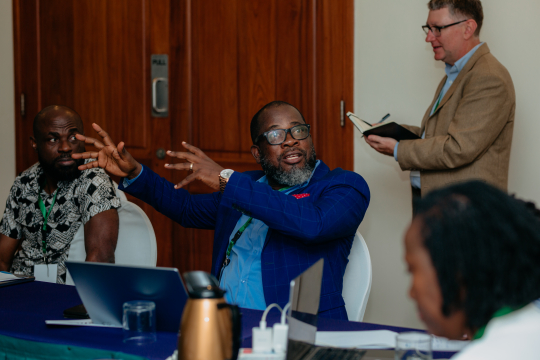
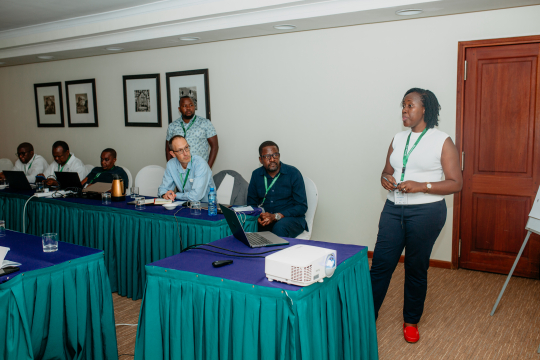
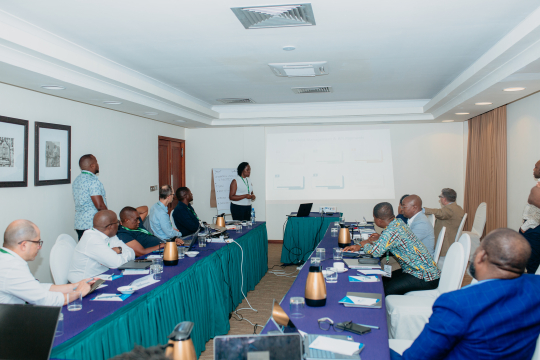
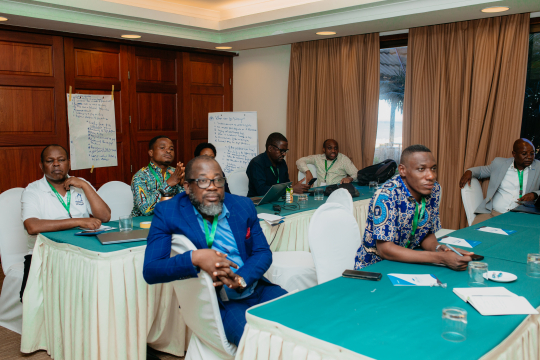
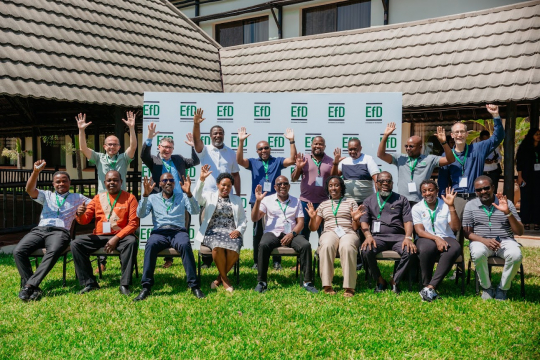
Water utility leaders from four African cities—Accra, Nairobi, Kampala, and Dar es Salaam—came together for a unique workshop aimed at sharing experiences and building stronger ties with researchers working on water-related challenges. The event, initiated by the Water Systems Group of the Natural Capital Collaborative (Martine Visser, Roger Madrigal, Joseph Cook, and David Fuente), was held alongside the EfD Annual Meeting and marked a significant step toward collaborative problem-solving in the water sector.
The workshop brought together key staff from Ghana Water Company Limited, Nairobi City Water and Sewerage Company (NCWSC), and Dar es Salaam Water and Sewerage Authority (DAWASA), and the National Water and Sewerage Corporation (Uganda).
The idea for the workshop came from a more than decade-long, fruitful collaboration between NCWSC and EfD Kenya. The other companies have more recently connected with EfD centers.
“It was a very good workshop where we got the opportunity to share our practical experiences with the other water companies,” said Josiah Gitu, Commercial Director at NCWSC.
The focus was on practical issues such as bill payment, infrastructure financing, and operational efficiency. Rather than presenting research findings, the organizers encouraged utility representatives to lead the conversation. Participants shared their experiences with billing systems, meter functionality, and customer engagement—highlighting common challenges such as non-payment and logistical hurdles in delivering bills.
“There was a lot of bonding because of shared experiences,” said David Fuente. “They realized they’re all facing similar problems, and that opened the door to deeper discussions.”
From experience to evidence
One of the workshop’s key insights was the realization that while utilities are actively trying various solutions to improve bill payment, few are evaluating their effectiveness. This sparked interest in working more closely with EfD researchers to develop evidence-based approaches.
“One issue that continues to be a big challenge for the water companies is the arrears. We need more research to understand why, despite our various strategies, they continue to go up,” noted Josiah Gitu.
Having this workshop in connection with EfD’s Annual Meeting opened the doors for the water company staff to EfD’s wide network of researchers and gave them a fuller picture of what the organization is all about. In addition to their own workshop, they could attend presentations by the researchers. For instance, a plenary talk by Professor Dale Whittington on water and the circular economy added a broader perspective.
Still, the most important takeaways were, according to the participants, the discussions with their peers on their shared experiences.
Building a community of practice
The workshop was never intended as a one-off event. Thanks to new funding awarded to the Natural Capital collaborative research program’s (NatCap) Water Systems Group, the plan is to reconvene the utilities four times over the next two years. A shared platform has already been created to maintain momentum and share updates.
“The workshop was much better than we could have hoped,” said Joe Cook. “There was genuine energy in the room for the peer-to-peer learning, and we identified several promising opportunities for research that can improve utility practice.”
Participants also gained a clearer view of EfD’s mission and the potential for collaboration. Many left energized and eager to work with EfD centers to improve service delivery and financial sustainability.
By: Petra Hansson