Event Information
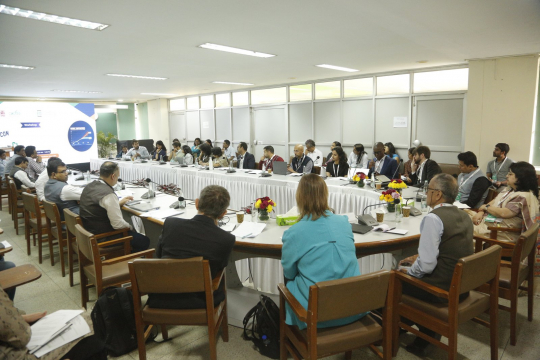
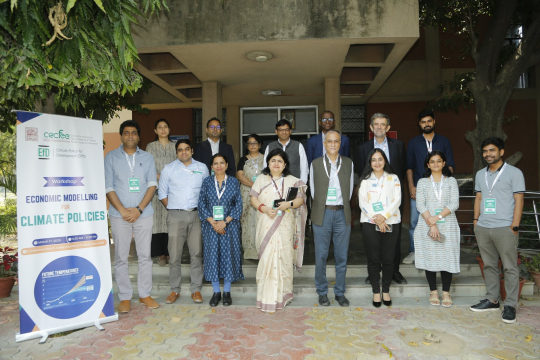
The Centre for Research on the Economics of Climate, Food, Energy and Environment (CECFEE), EfD India centre, convened a high-level workshop on "Economic Modelling for Climate Policies" on March 17, 2025, at ISI, New Delhi.
As India accelerates its decarbonization efforts while pursuing sustained economic growth, the workshop offered a timely forum to explore how macroeconomic modelling tools can inform the design of climate policies that are both environmentally effective and socially equitable.
The workshop brought together senior government officials, academics, and climate policy experts to deliberate on India's climate commitments (including its 2070 net-zero emissions target), and how these can be achieved alongside the government's "Viksit Bharat" vision of becoming a developed economy by 2047. Participants examined the role of carbon pricing mechanisms, emissions trading systems, and climate finance in steering investments toward a low-carbon economy, while addressing the need for inclusive development.
Opening Session
The workshop began with opening remarks from Prof. Antar Bandyopadhyay (Head, ISI Delhi Centre) and Prof. E. Somanathan (Head, CECFEE), who underscored the need to align climate ambitions with the government's vision of achieving “Viksit Bharat” by 2047. The “Viksit Bharat” (developed economy) target aims to raise the level of per capita income to USD 18,000 by 2047. The keynote address by Dr. V. Anantha Nageswaran, India's Chief Economic Advisor, stressed that “economic development would be India’s best insurance against climate change.”
Given India’s low per capita emissions, Dr. Nageswaran emphasized the importance of investigating inequality in per capita carbon emissions across and within countries. Per capita CO2e emissions in the United States are on average close to 14 tCO2e per year, which are nearly seven times those of India’s per capita emissions (approximately 2 tCO2e/year). Timely access to reliable energy would be needed to achieve sustained economic growth and uplift millions out of energy poverty. Transition fuels thus may be needed to ensure universal energy access, even as renewables are better integrated into the Indian electricity grid.
Carbon Markets and Emissions Trading
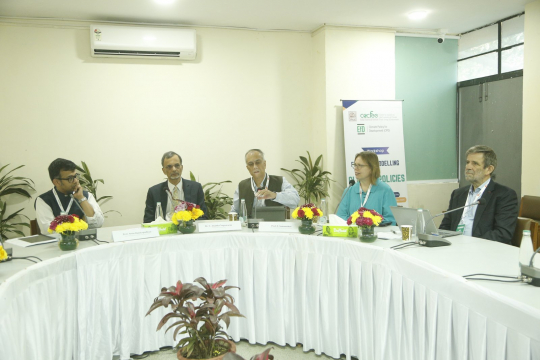
Chaired by Dr. Kanishka Kacker (Deputy Head, CECFEE), this session featured presentations from distinguished economists. Dr. Carolyn Fischer (World Bank) brought deep expertise on climate policy instrument design, particularly on rate-based emissions trading schemes and their optimal design. Dr. Shoibal Chakravarty (IISc) presented results from a CGE model which explores optimal mixes of coal taxes and renewable energy subsidies for the green transition.
These presentations were followed by a panel discussion on climate policy for India, moderated by Dr. Anant Sudarshan (University of Warwick and EPIC, Chicago). The session brought together key policymakers from government, including Smt. Chandni Raina, Advisor at the Ministry of Finance and Shri Arijit Sengupta, Director at the Bureau of Energy Efficiency.
The panel discussed the role of climate finance, technology transfer and international cooperation on global mitigation efforts. The discussions also shed light on the recently notified “Carbon Credit Trading Scheme” (CCTS), which aims to reduce industrial emissions by setting performance standards and enabling market-based trading of carbon credits between firms.
Panellists also expressed concern with the European Union's proposed Carbon Border Adjustment Mechanism (CBAM), scheduled for rollout in 2026, which poses competitive challenges for Indian exporters by potentially imposing tariffs on carbon-intensive imports into the EU. Policymakers raised concerns apropos Indian industry’s global competitiveness in light of the potentially high short-term costs on industry. The panel underscored the importance of existing government programmes launched by the BEE that aim to improve energy efficiency and reduce firms’ emissions intensity of output.
The Climate Policies for Development (CPfD) Collaborative
This session featured the EfD Initiative’s Climate Policies for Development (CPfD) collaborative, with the session chaired by Prof. Thomas Sterner (University of Gothenburg and co-lead of CPfD), bringing to focus a rich international perspective to India's climate policy challenges. Prof. Sterner presented research on public support for climate policies based on a survey from Swedish taxpayers, which found that high levels of trust in government and perceptions of fairness between various income groups are vital for public support towards carbon pricing.
The session featured presentations by Prof. Jan Steckel (PIK, Potsdam), co-lead of CPfD and Prof. Nnaemeka Chukwuone (University of Nigeria, Nsukka), Director of EfD Nigeria. Prof. Steckel presented research from a modelling study on the distributional effects of carbon pricing in developing countries, including India, highlighting the role of income and socio-economic factors such as car and appliance ownership as key driving factors for emissions growth.
Prof. Chukwuone brought critical insights from the Nigerian context, discussing the recently enacted National Action Plan on Climate Change. He elaborated on the potential for carbon markets and international climate finance mechanisms in unlocking investments for clean technology and better infrastructure for Nigeria and the Sub-Saharan African region.
The presentations were followed by another panel discussion which featured domestic civil society experts on climate change and economic modelling. The session was chaired by Prof. E. Somanathan (Head, CECFEE) and co-lead of CPfD. The panel featured Dr. Saon Ray (ICRIER, New Delhi), Dr. Vaibhav Chaturvedi (CEEW, New Delhi), and Dr. Probal Ghosh (IRADe, New Delhi).
The panel discussed various economic modelling approaches, including CGE models and input-output analysis, to simulate how carbon pricing and emissions trading schemes could affect industrial competitiveness, household welfare, and overall economic growth. Dr. Ray emphasized the importance of understanding sectoral heterogeneity, particularly how small and medium enterprises might face distinct challenges under carbon pricing regimes. Dr. Chaturvedi presented results from an integrated assessment model to inform long-term pathways for power sector decarbonisation for India, exploring the combination of policies such as the proposed ETS and the Renewable Purchase Obligation (RPO) mandate, in determining the transition pathway. Dr. Ghosh similarly presented analysis from a CGE model to project future emissions.
The workshop spotlighted India's Carbon Credit Trading Scheme, which mandates emissions reductions per unit of output for key industries and enables permit trading to meet these standards. Strengthening existing coal taxes and enhancing frameworks for technology transfer emerged as critical steps to accelerate the clean energy transition. Participants acknowledged that while carbon pricing can impose short-term social costs, international climate finance and well-designed revenue recycling mechanisms could potentially mitigate these impacts and facilitate a just and inclusive transition.